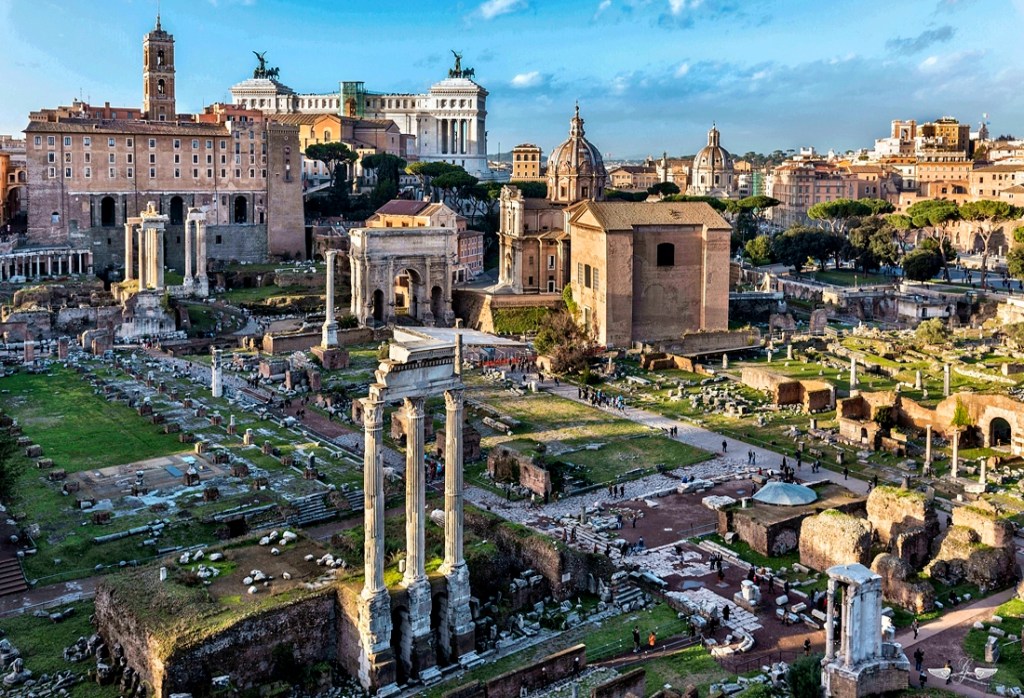
Acts 28 brings us to the climax of the Book of Acts. The final destination of Paul’s travels is the capital of the Roman Empire. Here he proclaims the reign of a Greater Caesar (Kurios), a Greater King, and the beginning of a Greater Kingdom: the Kingdom of God (28:23, 31).
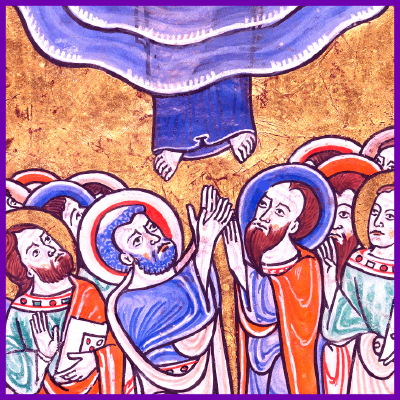
Acts ends like it began. Before his ascension, Jesus spoke “about the kingdom of God” (1:3); in the Roman Empire’s capital, Paul “proclaims the kingdom of God” (28:23, 31). The last chapter begins with the viper/serpent/Satan, which tried to kill Paul, being itself cast into the fire of judgment, and it ends with the crown rights of Jesus declared over all kingdoms of the earth.
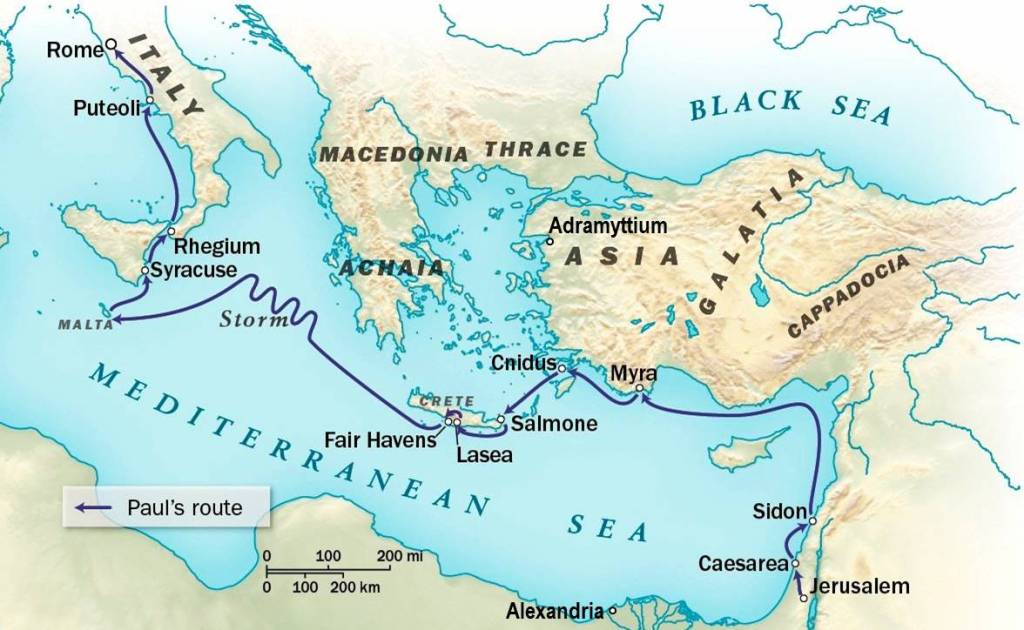
Paul on Malta
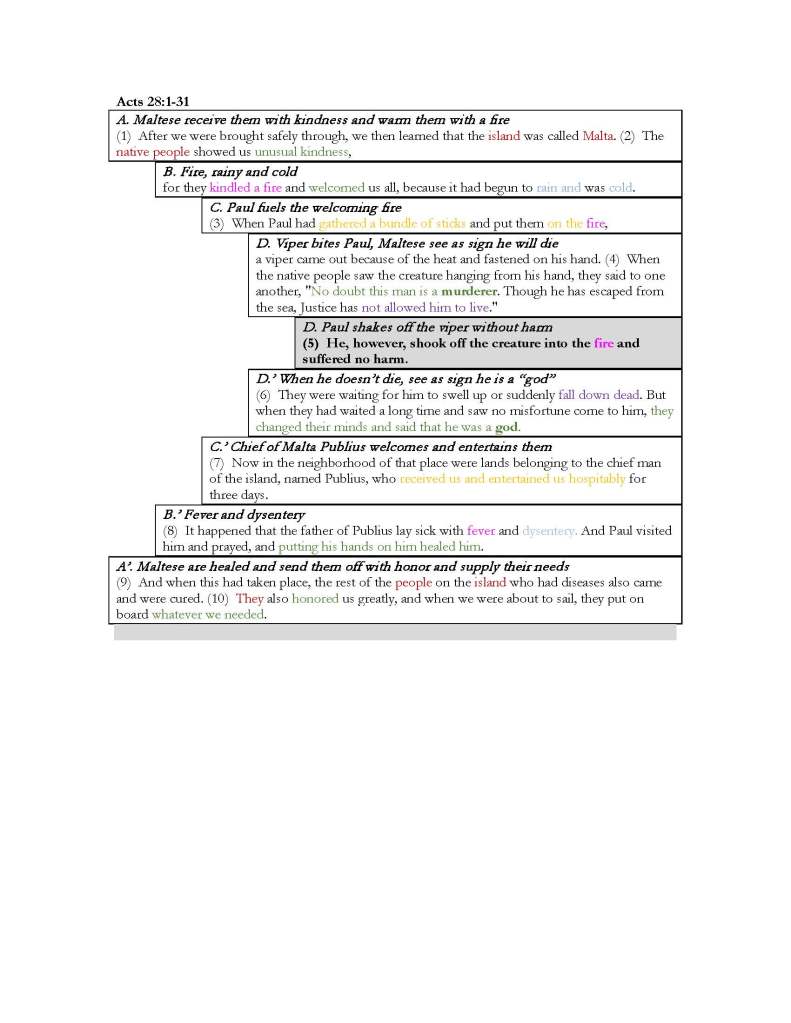
Notes on 28:1-10
28:2: unusual kindness: same sense as in 27:3, affection for people, friendliness; kindled a fire and welcomed us: the combination of these actions/terms suggests literally warm hospitality and the extension of extraordinary kindness and reception to strangers.
28:3-4: viper fastens on Paul’s hand: the term (snake, viper) can also be used to describe an evil person, much as in English, so no surprise the people assume Paul is a kindred spirit to a viper, such as a murderer or very evil person.
28:5+: fire: Luke mentions fire multiple times in this passage, from the welcoming fire of Maltese to the fever (Grk: fire of the body). The Maltese warm their visitors; Paul adds fuel to the fire by collecting wood; Paul shakes off/judges/burns up the serpent; Paul extinguishes the fire (heals) of Publius’s father.
28:5: shook off the creature into the fire: in contrast with the fire of welcome (vs. 2-3) and the fire of fever (v. 8), from which Publius’s father is healed, the center of this passage is a fire as judgment upon the viper/serpent/Satan, echoing John’s vision of Satan being cast into the the lake of fire in Rev. 20:10, 14-15:
“10 and the devil who had deceived them was thrown into the lake of fire and sulfur where the beast and the false prophet were, and they will be tormented day and night forever and ever. . . . 14 Then Death and Hades were thrown into the lake of fire. This is the second death, the lake of fire. 15 And if anyone’s name was not found written in the book of life, he was thrown into the lake of fire.”
revelation 20:10, 14-15
28:6: they changed their minds and said he was a god: if Paul can resist the bite of a deadly viper, then he must have divine-like powers, so their reaction is reasonable and reflects Mark 16:18*: “they will pick up serpents with their hands . . . it will not harm them.” (*FWIW, scholars note some of the earliest manuscripts do not include Mark 16:9-20).
28:7-10: Paul heals the father of Publius, the chief of the island, who may have been the one leading the island’s hospitality mentioned emphasized at the beginning of the chapter in 28:2. They are also treated very well at the end, with the islanders supplying Paul and his companions all they need for the remainder of their journey.
Paul arrives in Rome
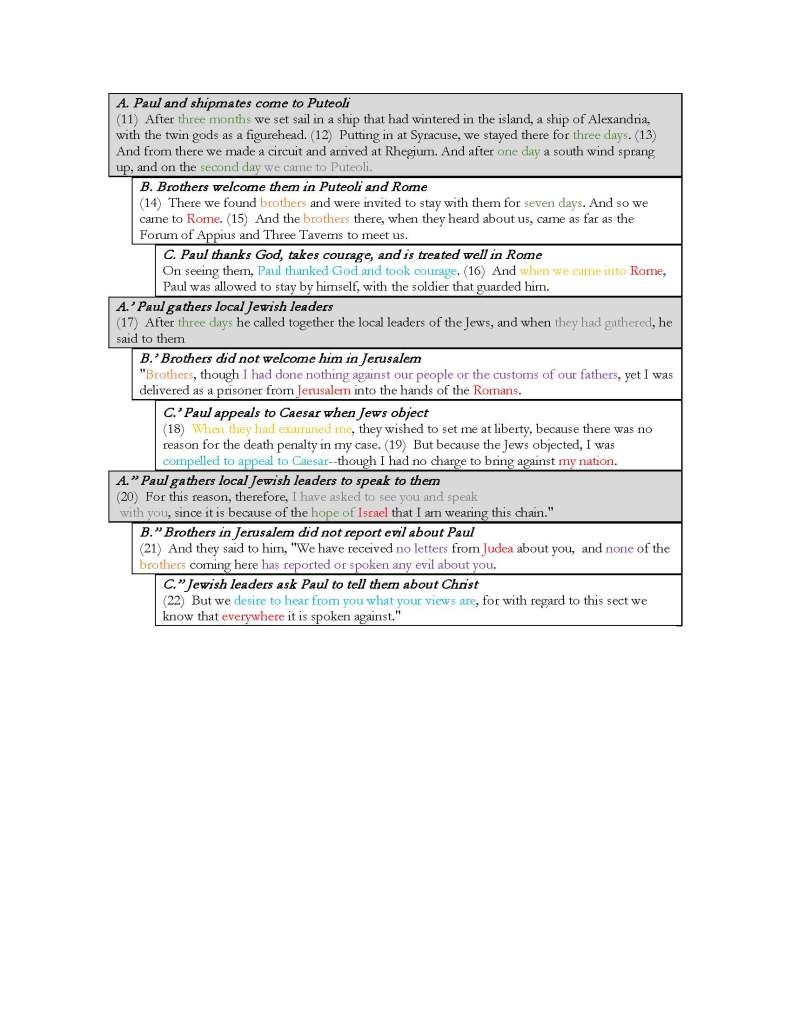
Notes on 28:11-22
This middle section of the final chapter of Acts has three parallel segments.
- The first one is quite positive about how Paul and his companions are received in Puteoli and Rome.
- The second explains how the Jews accused Paul falsely and forced him to appeal to Caesar.
- And the third segment ends with a remarkable turnabout: not only have the accusations against Paul not been passed on to authorities in Rome, but those who might have become his judges now ask Paul to explain the gospel to them! A great reversal has taken place.
One term repeated in the middle of each of the three segments is brothers. Like Luke’s references to fire in the first 10 verses, brothers moves from a very positive reference in the first instance, to a very negative sense, and finally it ends positively when the accusation is abandoned and the gospel pursued.
Just as the viper/serpent was destroyed in 28:5, so Satan, the Great Accuser, is cast down in Rev. 12:7-12:
9 And the great dragon was thrown down, that ancient serpent, who is called the devil and Satan, the deceiver of the whole world—he was thrown down to the earth, and his angels were thrown down with him. 10 And I heard a loud voice in heaven, saying, “Now the salvation and the power and the kingdom of our God and the authority of his Christ have come, for the accuser of our brothers has been thrown down, who accuses them day and night before our God. 11 And they have conquered him by the blood of the Lamb and by the word of their testimony, for they loved not their lives even unto death. 12 Therefore, rejoice, O heavens and you who dwell in them! But woe to you, O earth and sea, for the devil has come down to you in great wrath, because he knows that his time is short!”
Revelation 12:7-12
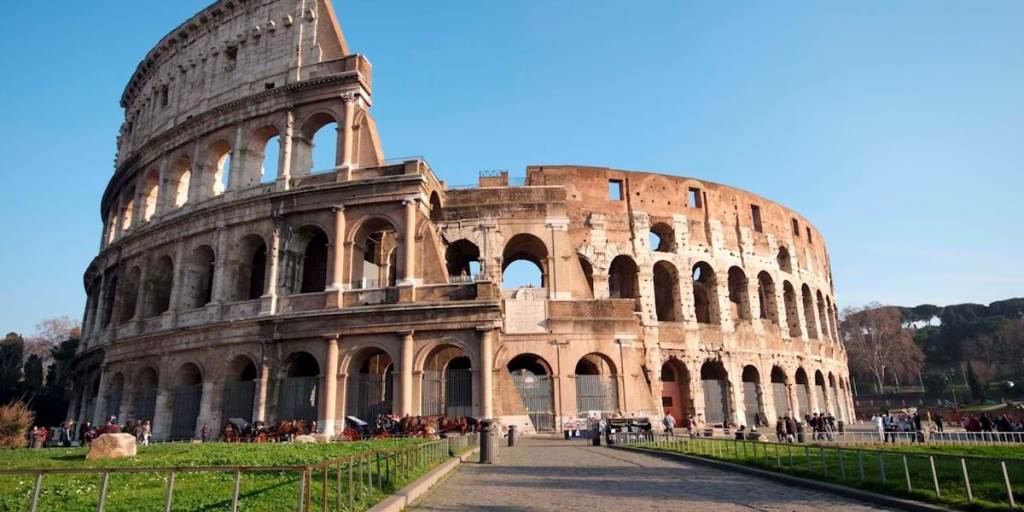
Paul declares the Kingdom of God
in the heart of the Roman Empire
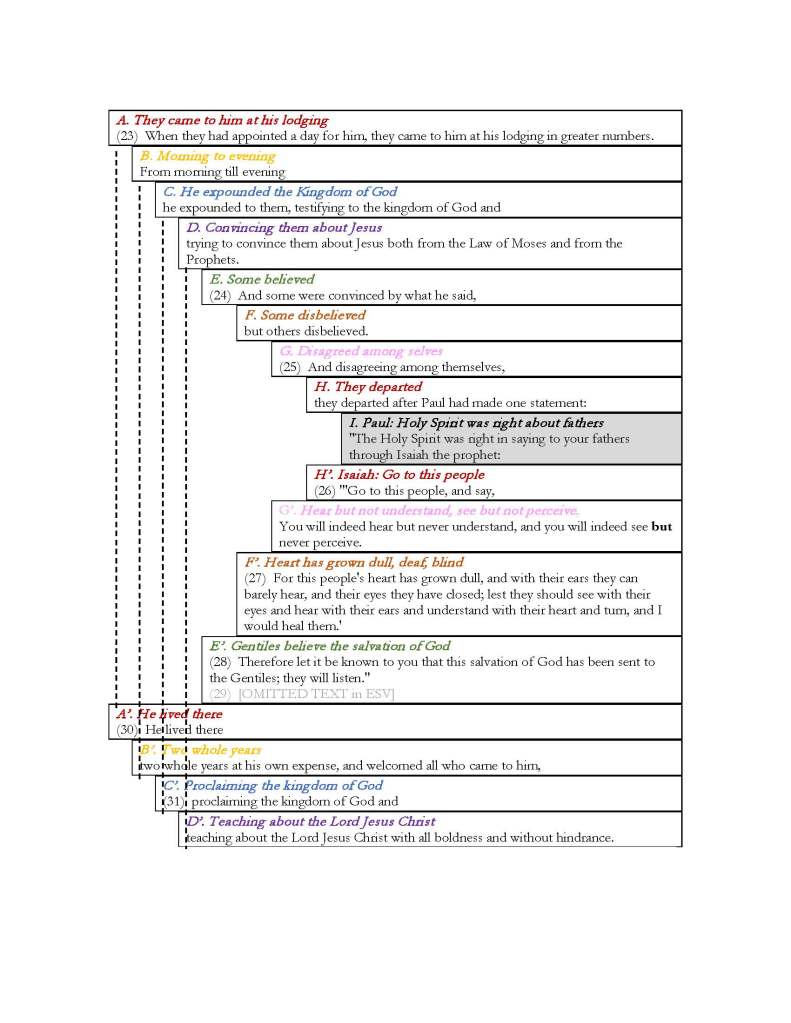
Notes on 28: 23-31
This final section has a parallel construction (A,B,C,D//A’, B’, C’,D’), surrounding a chiasm (E/E’-I). The parallel highlights
- A/A’: his dwelling (his lodging/he lived there)
- B/B’: a time period (morning to evening/two whole years)
- C/C’: proclaiming the Kingdom of God (expounded, testifying about /proclaiming the Kingdom)
- D/D’: teaching about Jesus (convincing them/teaching them about Jesus).
The climax of the last chapter of Acts centers chiastically on Paul’s quotation of Isaiah 6:9-10.
8 And I heard the voice of the Lord saying, “Whom shall I send, and who will go for us?” Then I said, “Here I am! Send me.” 9 And he said, “Go, and say to this people:
Isaiah 6:7-10‘Keep on hearing, but do not understand; keep on seeing, but do not perceive.’ 10 Make the heart of this people dull, and their ears heavy, and blind their eyes; lest they see with their eyes, and hear with their ears, and understand with their hearts, and turn and be healed.”
The contrast developed here by Luke is between the unbelief of the Jews prophesied by Isaiah, and the belief that is growing among the Gentiles. That shift is highlighted in 28:28, 31.

This panel on the interior of the Arch of Titus depicts Titus returning with the spoils of the Jewish Temple (menorah, candlesticks, etc.) after the destruction of Jerusalem in A.D. 70.,
which marked the end of temple worship for the Jews in Jerusalem–to this day.
Recommended Readings
Clinton Arnold, Acts (Zondervan, 2002)
David A. Dorsey, The Literary Structure of the Old Testament: A Commentary on Genesis-Malachi (Baker Academic, 1999)
Luke Timothy Johnson, The Acts of the Apostles (Sacra Pagina, Liturgical Press, 1992)
James B. Jordan, Through New Eyes: Developing a Biblical View of the World (Wipf and Stock Publishers, 1999)
Peter J. Leithart, A House for My Name: A Survey of the Old Testament (Canon Press, 2000)
Victor M. Wilson, Divine Symmetries: The Art of Biblical Rhetoric (1997)
“Recovering the Old Testament as a text in which Christians live and move and have their being is one of the most urgent tasks before the church. Reading the Reformers is good and right. Christian political activism has its place. Even at their best, however, these can only bruise the heel of a world that has abandoned God. But the Bible–the Bible is a sword to divide joints from marrow, a weapon to crush the head.”
Peter Leithart, The Kingdom and the Power
 Ascended King
You must be logged in to post a comment.