“Revelation does not predict the end of the physical universe; it uses the imagery of cosmic collapse to unveil the end of the old creation. But it is plausible to assume that the end of the old world foreshadows in some respects the end of the new. Besides, part of Revelation is literally about the final, postmillennial judgment (→20:11–21:8), and we will see that Revelation itself indicates that the end of the first age foreshadows the end of the last.”
Peter Leithart, Commentary on Revelation
Preterism
Preterism interprets some (partial preterism) or all (full preterism) prophecies of the Bible as events which have already happened. This school of thought interprets Daniel as referring to events that happened from the 7th century BC until the first century AD, while seeing the prophecies of Matthew 24 (etc.) and Revelation as events that happen mostly in the First Century A.D.. Preterism views the church as God’s chosen people, following Israel’s rejection of Christ as Messiah. The Old Covenant Age ends when Jewish sacrifices end in Jerusalem with the destruction of the Temple in A.D. 70., prophesied by Jesus in Matthew 24. Partial preterists believe Christ will return again at the end of the New Covenant age (Rev. 20-21). Preterism is long associated with post-millenialism, which was popular from the early church to the late 19th century.
Historicism
Historicism, a method of interpretation of Biblical prophecies, associates symbols with historical persons, nations or events. It can result in a view of progressive and continuous fulfillment of prophecy covering the period from Biblical times to the Second Coming. Almost all Protestant Reformers from the Reformation into the 19th century held historicist views.
Futurism
In Futurism, prophesies may be linked to some historical events, but most refer to events which have not yet been fulfilled. Most will take place at the end of the age and the end of the world. Most prophecies will be fulfilled during a global time of chaos known as the Great Tribulation and afterwards. Futurist beliefs usually have a close association with Premillennialism and Dispensationalism. Futurist beliefs are the foundation to the Left Behind series.
Idealism
Idealism (also called the spiritual approach, the allegorical approach or nonliteral approach) sees all of the imagery of the book as symbolic, not literal.
Chiastic Structure of Revelation
James Jordan:
The book of Revelation as a whole is structured chiastically.
A. John and Jesus, 1
B. Churches, 2–3
C. Throne/s in Heaven, 4–5
D. Horses, 6:1–8 (first four seals)
E. Saints Under Altar, 6:9–11 (5th seal)
F. Judgment Starts, 6:12–17 (6th seal)
G. Saints Sealed on Earth, 7
H. Seven Trumpets Appear, 8:1–2
I. Pentecostal Era Begins, 8:3–5
J. Plants, 8:7
K. Gentiles, 8:8–9
L. Drink, 8:10–11
M. Heavens, 8:11–12
N. Army of Lies, 9:1–11
O. Army of Saints, 9:12–11:6
P. Massacre, 11:7–13
Q. Dragon, 12
Q’ Sea Beast, 13:1–10
P’ Massacre, 13:15
O’ Army of Saints, 14:1–3
N’ Army that does not lie, 14:4–5
M’ Heavens, 14:6–7
L’ Drink, 14:8
K’ Gentiles, 14:9–13
J’ Plants, 14:14–16
I’ Pentecostal Era Ends, 14:18
H’ Seven Bowls Appear, 15:1
G’ Saints in Heaven, 15:2–4
F’ Judgment Restarts, 15:5–18:24
E’ Saints in Heaven, 19:1–10
D’ Horses, 19:11–21
C’ Throne/s in Heaven, 20
B’ Church, 21:1–22:5
A’ John and Jesus, 22:6–21
Peter Leithart’s Commentary on Revelation:
“Literally, the book [of Revelation] predicts a specific set of historical events that (mostly) take place soon after the book was written (preterist). Because God is consistent, these historical events are patterned by earlier events and pattern later historical sequences (idealist, historicist). Revelation depicts a double replay of exodus in first-century events, but later events might also qualify as exodus. As allegories and tropologies arise from the literal sense, so historicist and idealist readings arise from a preterist interpretation. Something like the trumpet sequence took place during the collapse of the Western Roman Empire, or in the later middle ages. John is not seeing or writing about those events directly, but they represent legitimate allegorical applications. John is not talking about us, but we may, will, and ought to seek analogies between what he is talking about and our own times. The better we learn the melody of the text, the more attuned we will be to contemporary (alternative rock?) renditions of that melody. Futurist approaches are not as easy to fit into a preterist framework, but if we follow the quadriga, we can tease out some anagogies.
Leithart, P. J. (2018). Revelation. (M. Allen & S. R. Swain, Eds.) (Vol. 1, p. 14). London; Oxford; New York; New Delhi; Sydney: Bloomsbury; Bloomsbury T&T Clark: An Imprint of Bloomsbury Publishing Plc.
Matthew 23b-24
Lament over Jerusalem
37 “O Jerusalem, Jerusalem, the city that kills the prophets and stones those who are sent to it! How often would I have gathered your children together as a hen gathers her brood under her wings, and you were not willing! 38 See, your house is left to you desolate. 39 For I tell you, you will not see me again, until you say, ‘Blessed is he who comes in the name of the Lord.’ ”
Jesus Foretells Destruction of the Temple
24 Jesus left the temple and was going away, when his disciples came to point out to him the buildings of the temple. 2 But he answered them, “You see all these, do you not? Truly, I say to you, there will not be left here one stone upon another that will not be thrown down.”
Signs of the End of the Age
3 As he sat on the Mount of Olives, the disciples came to him privately, saying, “Tell us, when will these things be, and what will be the sign of your coming and of the end of the age?” 4 And Jesus answered them, “See that no one leads you astray. 5 For many will come in my name, saying, ‘I am the Christ,’ and they will lead many astray. 6 And you will hear of wars and rumors of wars. See that you are not alarmed, for this must take place, but the end is not yet. 7 For nation will rise against nation, and kingdom against kingdom, and there will be famines and earthquakes in various places. 8 All these are but the beginning of the birth pains. 9 “Then they will deliver you up to tribulation and put you to death, and you will be hated by all nations for my name’s sake. 10 And then many will fall away and betray one another and hate one another. 11 And many false prophets will arise and lead many astray. 12 And because lawlessness will be increased, the love of many will grow cold. 13 But the one who endures to the end will be saved. 14 And this gospel of the kingdom will be proclaimed throughout the whole world as a testimony to all nations, and then the end will come.
The Abomination of Desolation
15 “So when you see the abomination of desolation spoken of by the prophet Daniel, standing in the holy place (let the reader understand), 16 then let those who are in Judea flee to the mountains. 17 Let the one who is on the housetop not go down to take what is in his house, 18 and let the one who is in the field not turn back to take his cloak. 19 And alas for women who are pregnant and for those who are nursing infants in those days! 20 Pray that your flight may not be in winter or on a Sabbath. 21 For then there will be great tribulation, such as has not been from the beginning of the world until now, no, and never will be. 22 And if those days had not been cut short, no human being would be saved. But for the sake of the elect those days will be cut short. 23 Then if anyone says to you, ‘Look, here is the Christ!’ or ‘There he is!’ do not believe it. 24 For false christs and false prophets will arise and perform great signs and wonders, so as to lead astray, if possible, even the elect. 25 See, I have told you beforehand. 26 So, if they say to you, ‘Look, he is in the wilderness,’ do not go out. If they say, ‘Look, he is in the inner rooms,’ do not believe it. 27 For as the lightning comes from the east and shines as far as the west, so will be the coming of the Son of Man. 28 Wherever the corpse is, there the vultures will gather.
The Coming of the Son of Man
29 “Immediately after the tribulation of those days the sun will be darkened, and the moon will not give its light, and the stars will fall from heaven, and the powers of the heavens will be shaken. 30 Then will appear in heaven the sign of the Son of Man, and then all the tribes of the earth will mourn, and they will see the Son of Man coming on the clouds of heaven with power and great glory. 31 And he will send out his angels with a loud trumpet call, and they will gather his elect from the four winds, from one end of heaven to the other.
An Oracle Concerning BabylonIsaiah 13:10
"For the stars of the heavens and their constellations will not give their light; the sun will be dark at its rising, and the moon will not shed its light.“
Daniel’s Vision in Babylon
“I saw in the night visions,
Daniel 7:13-14and behold, with the clouds of heaven there came one like a son of man, and he came to the Ancient of Days and was presented before him. And to him was given dominion and glory and a kingdom, that all peoples, nations, and languages should serve him; his dominion is an everlasting dominion, which shall not pass away, and his kingdom one that shall not be destroyed.“
The Lesson of the Fig Tree
32 “From the fig tree learn its lesson: as soon as its branch becomes tender and puts out its leaves, you know that summer is near. 33 So also, when you see all these things, you know that he is near, at the very gates. 34 Truly, I say to you, this generation will not pass away until all these things take place. 35 Heaven and earth will pass away, but my words will not pass away.
No One Knows That Day and Hour
36 “But concerning that day and hour no one knows, not even the angels of heaven, nor the Son, but the Father only. 37 For as were the days of Noah, so will be the coming of the Son of Man. 38 For as in those days before the flood they were eating and drinking, marrying and giving in marriage, until the day when Noah entered the ark, 39 and they were unaware until the flood came and swept them all away, so will be the coming of the Son of Man. 40 Then two men will be in the field; one will be taken and one left. 41 Two women will be grinding at the mill; one will be taken and one left. 42 Therefore, stay awake, for you do not know on what day your Lord is coming. 43 But know this, that if the master of the house had known in what part of the night the thief was coming, he would have stayed awake and would not have let his house be broken into. 44 Therefore you also must be ready, for the Son of Man is coming at an hour you do not expect. 45 “Who then is the faithful and wise servant, whom his master has set over his household, to give them their food at the proper time? 46 Blessed is that servant whom his master will find so doing when he comes. 47 Truly, I say to you, he will set him over all his possessions. 48 But if that wicked servant says to himself, ‘My master is delayed,’ 49 and begins to beat his fellow servants and eats and drinks with drunkards, 50 the master of that servant will come on a day when he does not expect him and at an hour he does not know 51 and will cut him in pieces and put him with the hypocrites. In that place there will be weeping and gnashing of teeth.
The Holy Bible: English Standard Version. (2016). (Mt 23:37–24:51). Wheaton, IL: Crossway Bibles.
Acts and Revelation
The book of Acts describes events of the early church and the missionary labors of Peter, Paul, and others–from an earthly perspective (eyewitness accounts, personal observation, Luke 1: 1-4, Acts 1:1), from the vantage of the boots on the ground, as it were. The book of Revelation describes some of the same events and covers some of the same timeframe from a heavenly perspective–from John’s heavenly vision while “in the Spirit” (Revelation 1:10-11).
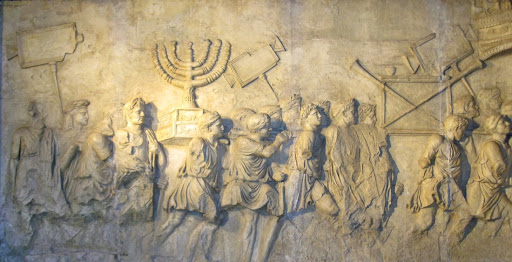
Acts: From Ascension to the Declaration of Christ’s Rule over All Nations
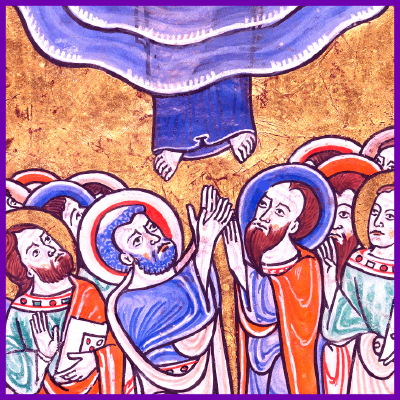
The events described in Acts run from roughly A.D. 33 to A.D. 62. The book begins with a description of Jesus’ teaching following his resurrection and his ascension into heaven before the eyes of his followers. The book ends with Paul under house arrest in Rome proclaiming the Kingdom of God and the sovereignty of King Jesus over all nations from the heart of the Roman Empire. Within a few short years of Acts’ conclusion, Rome will burn, Nero will launch a bloody persecution of the early Church, and Titus will destroy Jerusalem and pillage the Jewish Temple. The artifacts Titus takes from the Temple are immortalized in the Arch of Titus still standing, unlike the Temple, at the heart of the heart of the Roman Empire, the Roman Forum (pictured above). The destruction of Jerusalem and the Jewish Temple in A.D. 70 marks the end of Old Covenant sacrifices at the Temple once and for all–as it is today. The New Covenant has begun, and the Old Covenant has passed away. A new age of Christ’s reign and of his Church has dawned.
Peter Leithart, in his commentary on Revelation, describes the importance of the destruction of Jerusalem this way:
“The fall of Jerusalem was the collapse of this entire world-system. For the Bible, Jerusalem—not Babylon, Susa, Athens, or Rome—was the world’s chief city, and when judgment strikes the center, the whole structure fractures and falls. Around the same time, there were reverberations throughout the empire. It is no accident that the city of Rome experienced a shake-up during the years leading up to the destruction of Jerusalem. The Julio-Claudian dynasty ended with the suicide of Nero (68 AD), after which Rome was engulfed in the chaos of the “Year of the Four Emperors” (69 AD). Peace was restored when the Senate made Vespasian emperor in 69. The Roman Empire, of course, continued for centuries to dominate the Mediterranean, but its role as protector of Judaism ended. After Jerusalem had been thrown down, the oikoumene was over.“
Leithart, P. J., Revelation (London; Oxford; New York: T&T Clark, 2018), Vol. 1, p. 34.
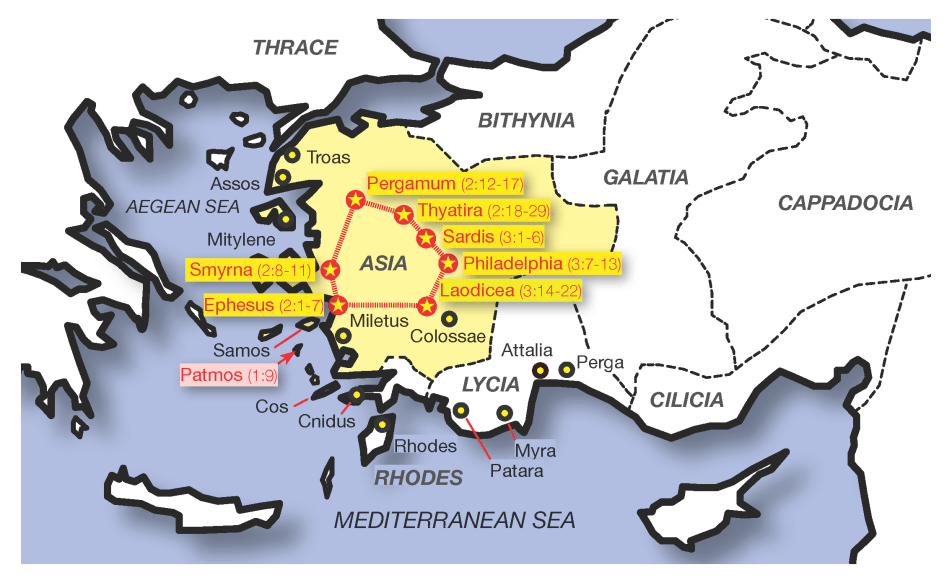
Revelation: From Christ’s Ascension to the Wedding Supper of the Lamb
The events described in Revelation, John says, “must soon take place” because “the time is near” (Rev. 1:1, 3). The book starts with short letters to the seven churches of “Asia” (that is, western Asia Minor, not the Orient; see map above, Rev. 1:4-3:22). Immediately after this, John, being “in the Spirit” (1:10, 4:2), has a vision of the throne room of God (4:2ff). We are witnessing events from a heavenly, even divine perspective. At God’s right hand is a scroll with seven seals that “no one was worthy to open or to look into it” (5:3). So John begins to weep. But he is told to stop weeping because “the Lion of the tribe of Judah, the Root of David, has conquered, so that he can open the scroll and its seven seals” (5:5). What we are witnessing along with John is the exaltation of the ascended Jesus to right hand of the throne of God the Father!!
8 And when he had taken the scroll, the four living creatures and the twenty-four elders fell down before the Lamb, each holding a harp, and golden bowls full of incense, which are the prayers of the saints. 9 And they sang a new song, saying,
“Worthy are you to take the scroll and to open its seals, for you were slain, and by your blood you ransomed people for God from every tribe and language and people and nation, 10 and you have made them a kingdom and priests to our God, and they shall reign on the earth.”11 Then I looked, and I heard around the throne and the living creatures and the elders the voice of many angels, numbering myriads of myriads and thousands of thousands, 12 saying with a loud voice,
“Worthy is the Lamb who was slain, to receive power and wealth and wisdom and might and honor and glory and blessing!”13 And I heard every creature in heaven and on earth and under the earth and in the sea, and all that is in them, saying,
“To him who sits on the throne and to the Lamb be blessing and honor and glory and might forever and ever!”14 And the four living creatures said, “Amen!” and the elders fell down and worshiped.
Revelation 5:8-14
We are witnessing in Revelation by John’s report the ascension and enthronement of Jesus from a heavenly perspective–the same events described by Luke in Acts from an earthly perspective. We see few details from our earth-bound vantage, but we see a coronation unlike any before or since:
9 After this I looked, and behold, a great multitude that no one could number, from every nation, from all tribes and peoples and languages, standing before the throne and before the Lamb, clothed in white robes, with palm branches in their hands, 10 and crying out with a loud voice, “Salvation belongs to our God who sits on the throne, and to the Lamb!” 11 And all the angels were standing around the throne and around the elders and the four living creatures, and they fell on their faces before the throne and worshiped God, 12 saying, “Amen! Blessing and glory and wisdom and thanksgiving and honor and power and might be to our God forever and ever! Amen.”
Revelation 7:9-12
A Timeline for Acts & Revelation
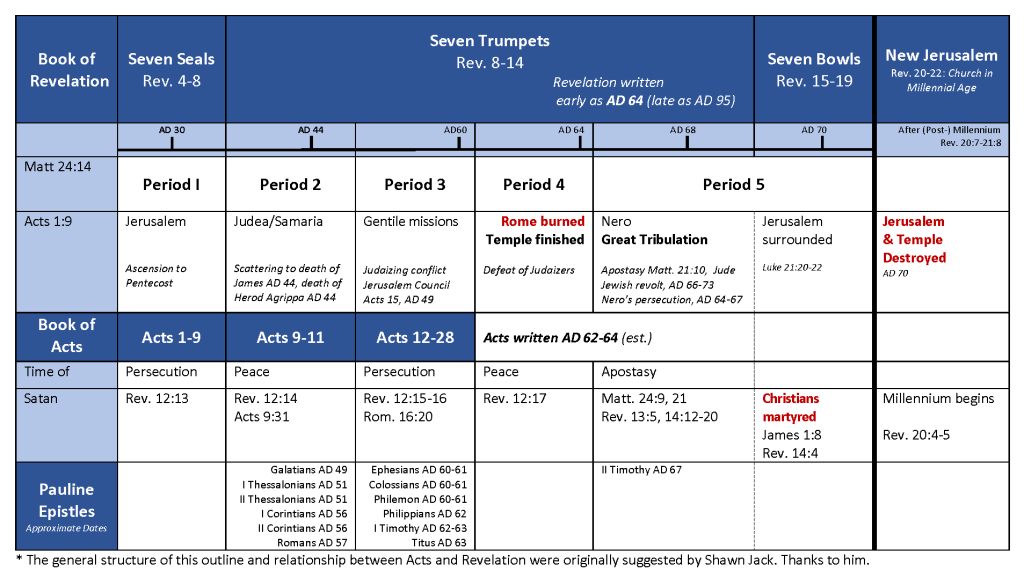
Shawn Jack, to whom I’m indebted for developing some of these connections between Acts and Revelation (and the basic timeline above), explains how Revelation overlaps with the story told in Acts.
 Ascended King
You must be logged in to post a comment.