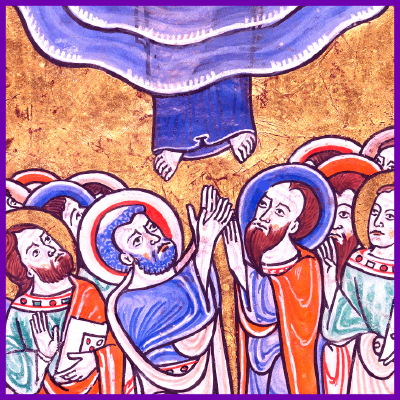
The book of Acts describes events of the early church and the missionary labors of Peter, Paul, and others–from an earthly perspective (eyewitness accounts, personal observation, Luke 1: 1-4, Acts 1:1), from the vantage of the boots on the ground, as it were. The book of Revelation describes some of the same events and covers some of the same timeframe from a heavenly perspective–from John’s heavenly vision while “in the Spirit” (Revelation 1:10-11).
Acts: From Ascension to the Declaration of Christ’s Rule over All Nations
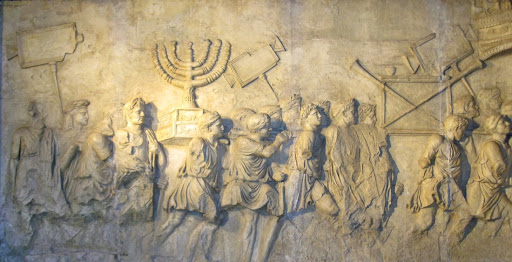
The events described in Acts run from roughly A.D. 33 to A.D. 62. The book begins with a description of Jesus’ teaching following his resurrection and his ascension into heaven before the eyes of his followers. The book ends with Paul under house arrest in Rome proclaiming the Kingdom of God and the sovereignty of King Jesus over all nations from the heart of the Roman Empire. Within a few short years of Acts’ conclusion, Rome will burn, Nero will launch a bloody persecution of the early Church, and Titus will destroy Jerusalem and pillage the Jewish Temple. The artifacts Titus takes from the Temple are immortalized in the Arch of Titus still standing, unlike the Temple, at the heart of the heart of the Roman Empire, the Roman Forum (pictured above). The destruction of Jerusalem and the Jewish Temple in A.D. 70 marks the end of Old Covenant sacrifices at the Temple once and for all–as it is today. The New Covenant has begun, and the Old Covenant has passed away. A new age of Christ’s reign and of his Church has dawned.
Peter Leithart, in his commentary on Revelation, describes the importance of the destruction of Jerusalem this way:
“The fall of Jerusalem was the collapse of this entire world-system. For the Bible, Jerusalem—not Babylon, Susa, Athens, or Rome—was the world’s chief city, and when judgment strikes the center, the whole structure fractures and falls. Around the same time, there were reverberations throughout the empire. It is no accident that the city of Rome experienced a shake-up during the years leading up to the destruction of Jerusalem. The Julio-Claudian dynasty ended with the suicide of Nero (68 AD), after which Rome was engulfed in the chaos of the “Year of the Four Emperors” (69 AD). Peace was restored when the Senate made Vespasian emperor in 69. The Roman Empire, of course, continued for centuries to dominate the Mediterranean, but its role as protector of Judaism ended. After Jerusalem had been thrown down, the oikoumene was over.“
Leithart, P. J., Revelation (London; Oxford; New York: T&T Clark, 2018), Vol. 1, p. 34.
Revelation: From Christ’s Ascension to the Wedding Supper of the Lamb
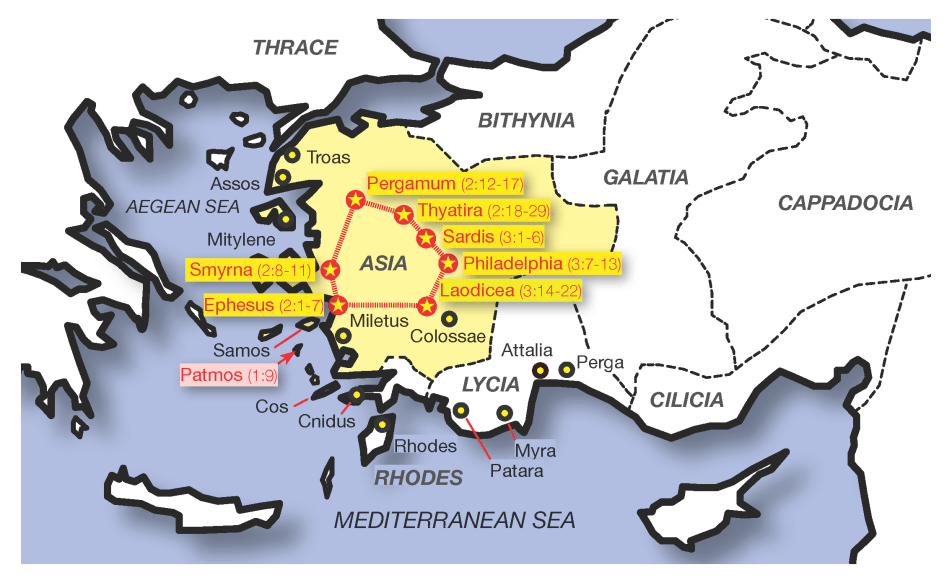
The events described in Revelation, John says, “must soon take place” because “the time is near” (Rev. 1:1, 3). The book starts with short letters to the seven churches of “Asia” (that is, western Asia Minor, not the Orient; see map above, Rev. 1:4-3:22). Immediately after this, John, being “in the Spirit” (1:10, 4:2), has a vision of the throne room of God (4:2ff). We are witnessing events from a heavenly, even divine perspective. At God’s right hand is a scroll with seven seals that “no one was worthy to open or to look into it” (5:3). So John begins to weep. But he is told to stop weeping because “the Lion of the tribe of Judah, the Root of David, has conquered, so that he can open the scroll and its seven seals” (5:5). What we are witnessing along with John is the exaltation of the ascended Jesus to right hand of the throne of God the Father!!
8 And when he had taken the scroll, the four living creatures and the twenty-four elders fell down before the Lamb, each holding a harp, and golden bowls full of incense, which are the prayers of the saints. 9 And they sang a new song, saying,
“Worthy are you to take the scroll and to open its seals, for you were slain, and by your blood you ransomed people for God from every tribe and language and people and nation, 10 and you have made them a kingdom and priests to our God, and they shall reign on the earth.”11 Then I looked, and I heard around the throne and the living creatures and the elders the voice of many angels, numbering myriads of myriads and thousands of thousands, 12 saying with a loud voice,
“Worthy is the Lamb who was slain, to receive power and wealth and wisdom and might and honor and glory and blessing!”13 And I heard every creature in heaven and on earth and under the earth and in the sea, and all that is in them, saying,
“To him who sits on the throne and to the Lamb be blessing and honor and glory and might forever and ever!”14 And the four living creatures said, “Amen!” and the elders fell down and worshiped.
Revelation 5:8-14
We are witnessing in Revelation by John’s report the ascension and enthronement of Jesus from a heavenly perspective–the same events described by Luke in Acts from an earthly perspective. We see few details from our earth-bound vantage, but we see a coronation unlike any before or since:
9 After this I looked, and behold, a great multitude that no one could number, from every nation, from all tribes and peoples and languages, standing before the throne and before the Lamb, clothed in white robes, with palm branches in their hands, 10 and crying out with a loud voice, “Salvation belongs to our God who sits on the throne, and to the Lamb!” 11 And all the angels were standing around the throne and around the elders and the four living creatures, and they fell on their faces before the throne and worshiped God, 12 saying, “Amen! Blessing and glory and wisdom and thanksgiving and honor and power and might be to our God forever and ever! Amen.”
Revelation 7:9-12
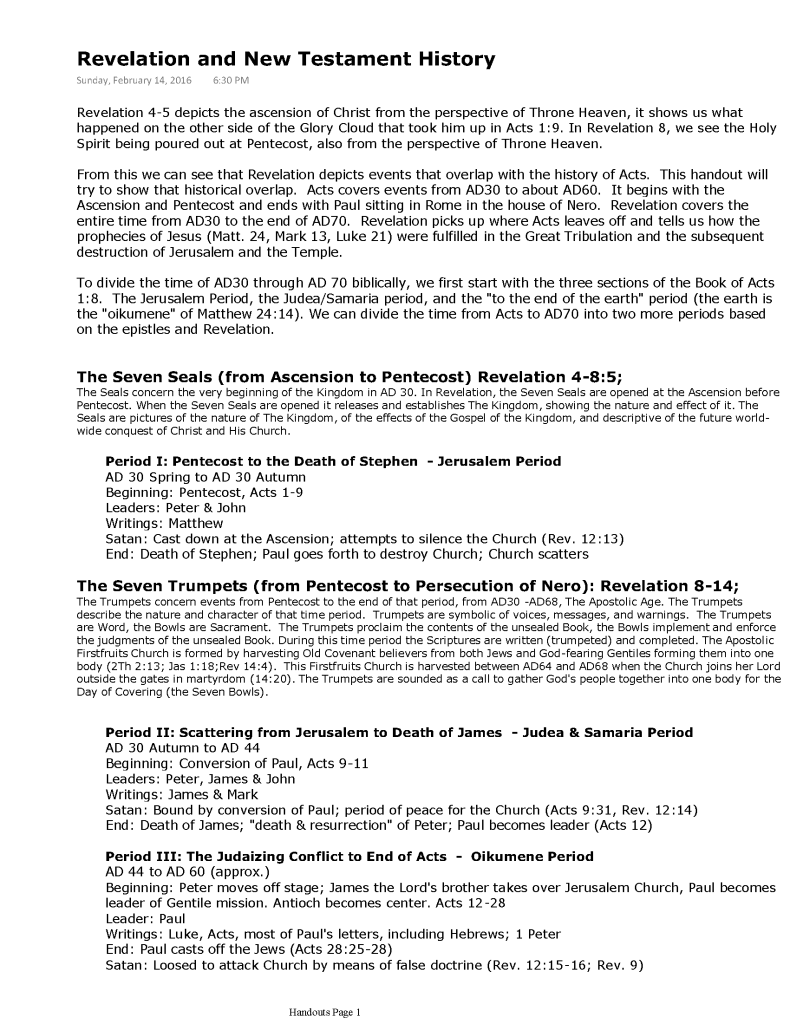
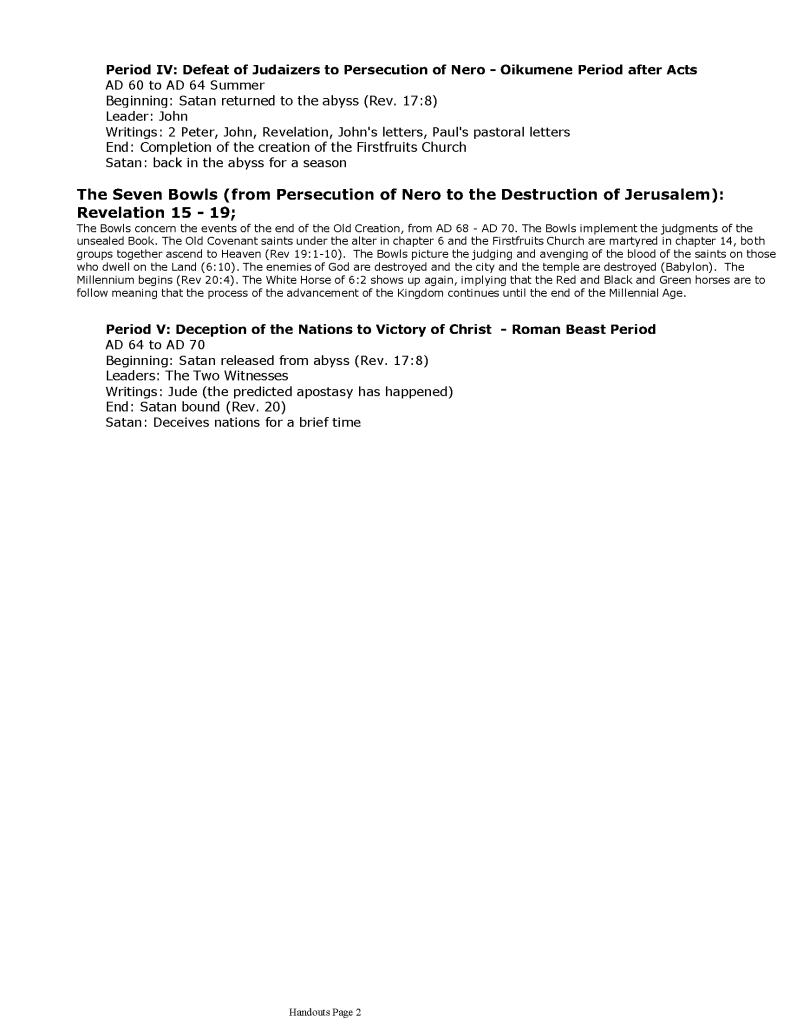
A Timeline for Acts & Revelation
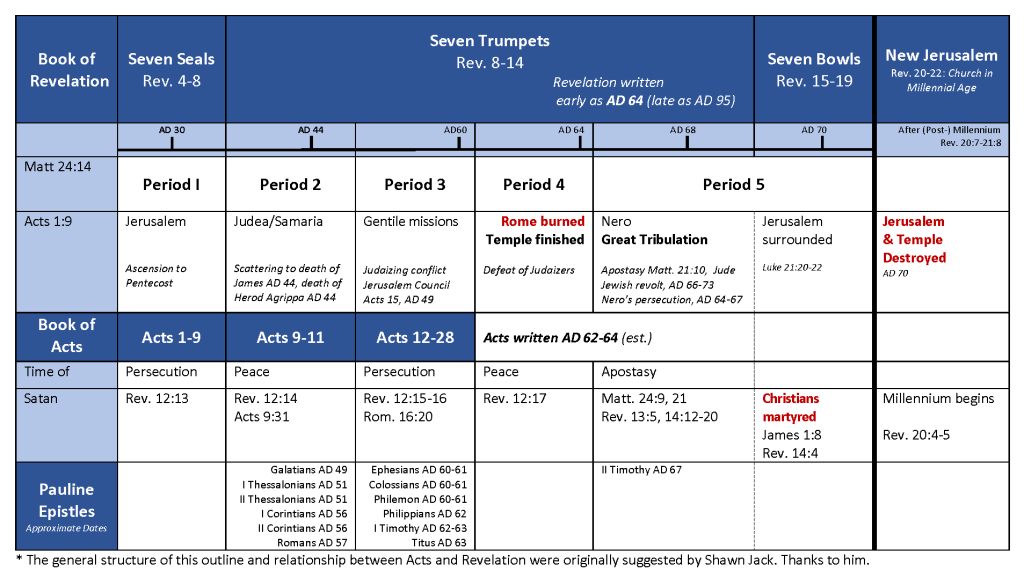
Shawn Jack, to whom I’m indebted for developing some of these connections between Acts and Revelation (and the basic timeline above), explains how Revelation overlaps with the story told in Acts.
9 And the great dragon was thrown down, that ancient serpent, who is called the devil and Satan, the deceiver of the whole world—he was thrown down to the earth, and his angels were thrown down with him. 10 And I heard a loud voice in heaven, saying, “Now the salvation and the power and the kingdom of our God and the authority of his Christ have come, for the accuser of our brothers has been thrown down, who accuses them day and night before our God. 11 And they have conquered him by the blood of the Lamb and by the word of their testimony, for they loved not their lives even unto death. 12 Therefore, rejoice, O heavens and you who dwell in them! But woe to you, O earth and sea, for the devil has come down to you in great wrath, because he knows that his time is short!”
Revelation 12:7-12
“10 and the devil who had deceived them was thrown into the lake of fire and sulfur where the beast and the false prophet were, and they will be tormented day and night forever and ever. . . . 14 Then Death and Hades were thrown into the lake of fire. This is the second death, the lake of fire. 15 And if anyone’s name was not found written in the book of life, he was thrown into the lake of fire.”
revelation 20:10, 14-15
6 Then I heard what seemed to be the voice of a great multitude, like the roar of many waters and like the sound of mighty peals of thunder, crying out,
“Hallelujah! For the Lord our God the Almighty reigns. 7Let us rejoice and exult and give him the glory, for the marriage of the Lamb has come, and his Bride has made herself ready; 8it was granted her to clothe herself with fine linen, bright and pure”—for the fine linen is the righteous deeds of the saints.
9 And the angel said to me, “Write this: Blessed are those who are invited to the marriage supper of the Lamb.” And he said to me, “These are the true words of God.” 10 Then I fell down at his feet to worship him, but he said to me, “You must not do that! I am a fellow servant with you and your brothers who hold to the testimony of Jesus. Worship God.” For the testimony of Jesus is the spirit of prophecy.
Revelation 19:6-10
Then I saw a new heaven and a new earth, for the first heaven and the first earth had passed away, and the sea was no more. 2 And I saw the holy city, new Jerusalem, coming down out of heaven from God, prepared as a bride adorned for her husband. 3 And I heard a loud voice from the throne saying, “Behold, the dwelling place of God is with man. He will dwell with them, and they will be his people, and God himself will be with them as their God. 4 He will wipe away every tear from their eyes, and death shall be no more, neither shall there be mourning, nor crying, nor pain anymore, for the former things have passed away.”
5 And he who was seated on the throne said, “Behold, I am making all things new.” Also he said, “Write this down, for these words are trustworthy and true.” 6 And he said to me, “It is done! I am the Alpha and the Omega, the beginning and the end. To the thirsty I will give from the spring of the water of life without payment. 7 The one who conquers will have this heritage, and I will be his God and he will be my son. . . .”
Revelation 21:1-7
Revelation completes the story of Acts and does so from its heavenly vantage point. What began in Acts and Revelation with the ascension and coronation of King Jesus culminates not in the enthronement of Jeus, but of his saints. As Leithart puts it,
“Revelation focuses not on the enthronement of Jesus, but on the enthronement of the saints. Jesus the Son of Man proves himself Jesus the Ancient of Days, conferring and not merely receiving a kingdom. Contrary to the popular summary, the message of Revelation is not: Jesus wins. When Revelation begins, Jesus has won. He is already glorified; he has already received the kingdom. The message is: We win, by faithful witness and song; and, in triumphing through Jesus, we receive the kingdom. Revelation is not good news about the death and resurrection of Jesus for the sins of the world. It is the good news that sacrificial deaths and vindication of martyrs bring the collapse of the old creation and initiate the new.
LEITHART, P. J., REVELATION (LONDON; OXFORD; NEW YORK: T&T CLARK, 2018), VOL. 1, P. 35.
Recommended Readings
Clinton Arnold, Acts (Zondervan, 2002)
David A. Dorsey, The Literary Structure of the Old Testament: A Commentary on Genesis-Malachi (Baker Academic, 1999)
Luke Timothy Johnson, The Acts of the Apostles (Sacra Pagina, Liturgical Press, 1992)
James B. Jordan, Through New Eyes: Developing a Biblical View of the World (Wipf and Stock Publishers, 1999)
Peter J. Leithart, A House for My Name: A Survey of the Old Testament (Canon Press, 2000)
Victor M. Wilson, Divine Symmetries: The Art of Biblical Rhetoric (1997)
“Recovering the Old Testament as a text in which Christians live and move and have their being is one of the most urgent tasks before the church. Reading the Reformers is good and right. Christian political activism has its place. Even at their best, however, these can only bruise the heel of a world that has abandoned God. But the Bible–the Bible is a sword to divide joints from marrow, a weapon to crush the head.”
Peter Leithart, The Kingdom and the Power
 Ascended King
You must be logged in to post a comment.