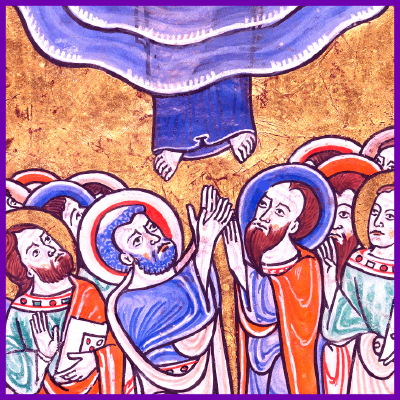
Joshua-Acts: From Moses-Aaron-Joshua to Jesus-Peter-Paul; Egypt-Wilderness-Promised Land to Judea-Samaria-End of the Earth
Luke 24:13-27: On the Road to Emmaus
That very day two of them were going to a village named Emmaus, about seven miles from Jerusalem, and they were talking with each other about all these things that had happened. While they were talking and discussing together, Jesus himself drew near and went with them. But their eyes were kept from recognizing him. . . . And he said to them, “O foolish ones, and slow of heart to believe all that the prophets have spoken! Was it not necessary that the Christ should suffer these things and enter into his glory?” And beginning with Moses and all the Prophets, he interpreted to them in all the Scriptures the things concerning himself.
Recommended Readings
David A. Dorsey, The Literary Structure of the Old Testament: A Commentary on Genesis-Malachi (Baker Academic, 1999)
James B. Jordan, “The Resurrection of Peter and the Coming of the Kingdom,” Biblical Horizons, No. 34 (February, 1992)
Peter J. Leithart, A House for My Name: A Survey of the Old Testament (Canon Press, 2000)
L. Michael Morales, Who Shall Ascend the Mountain of the Lord? A Biblical Theology of the Book of Leviticus (IVP, 2015)
Tim Chester & Jonny Woodrow, The Ascension: Humanity in the Presence of God (Christian Focus, 2013)
Lesson Outline
- Review: Key Points from the Last Lesson
- The Structure of the Old Testament Story: Genesis to Joshua
- OT Pattern for and Parallels with the NT Gospels & the Life of Jesus
- OT Pattern for the Book of Acts & the Conquest of the Gentile World
- OT Types & NT Antitypes for the Conquest of the World
1. Review: Key Points from the Last Lesson
A. Everywhere we look in creation, stunning complexities and structures abound. If God’s breath spoke all that glory and wonder into being by His Word, how much more should we see glories and wonders in His Word itself. If we only have eyes to see, its complexities and structures would take our breath away.
B. The Bible is not a phone book, encyclopedia, oracle, or helpful hints for better living. It is the very Word of our Creator-Redeemer-Sovereign God! We need to learn to read like King Jesus and the Apostle Paul, and how the other biblical writers read and interpreted the Old Testament. And most importantly, we need to let God’s Word shape and reshape us in His image, giving us new eyes and ears, new hearts, new lives.
C. All texts are a joke. “Like [all jokes], every text depends for its meaning on information lying outside the text. Every text is a joke, and a good interpreter is one with a good sense of humor, one with a broad knowledge and the wit to know what bits of knowledge are relevant. All interpretation is a matter of getting it. All texts mean the way jokes mean. Or, to put it more sharply, the text is a joke” (Leithart, Deep Exegesis, p. 115).
D. When we look at Scripture more closely, we should see the amazing structures God’s breath has imprinted on his Word (and creation itself)–from the creation story, to the Pentateuch, to John-Revelation, and to Luke-Acts and beyond.
So let’s look at the Scriptures afresh with new eyes to see . . .
2. The Structure of the Old Testament Story: Genesis to Joshua
Layers of Complexity
You don’t need special glasses to read the Scriptures, like the ones Benjamin Franklin Gates wears in the film National Treasure to read the watermarks on the back of the U.S. Declaration of Independence, but there are multiple layers of meaning and perspective we need to look for in the Scriptures. The Bible is not a two-dimensional document with only one possible perspective, translation, or interpretation. Like the creation itself, the deeper or farther you look, the more you can discern amazingly complex, but interrelated structures in the creative Word. The two different structural analyses of the OT below illustrate this point by the way they note such differences when we look at the Old Testament covenantally or redemptively (or grammatically or chronologically, etc.).

The Covenantal Center of the Pentateuch: The Covenant at Sinai
The following covenantal structure of Genesis-Joshua is based on the analysis by David Dorsey, Literary Structure of the Old Testament, 1999, p. 101
A. Primeval History: Adam & nations receive allotted territories (Gen. 1-11)
B. Abraham: Promise of land and descendants to Abraham (Gen. 12-21:7)
C. Isaac & Death of Abraham: Sub-sacrifice & blessings (Gen. 21:8-28:4)
D. Jacob: evils of social and family discord (Gen. 28:5-37:1)
E. Joseph: Betrayed, God rewards faithful obedience (Gen. 37:2-50:26)
F. Exodus: Firstborn death, God saves Israel (Ex. 1:1-13:16)
G. Sin & Grace in Wilderness: migration, grace (Ex.13:17-19:2)
H. God speaks from cloud, gift of Law, plans for tabernacle, fills sanctuary—”tabernacles” with His people (Ex. 19:3-Num. 10:10)
G.’ Sin & Grace in Wilderness: migration, grace (Num. 10:11-21:20)
F.’ Victory in Moab: God saves Israel in foreign land (Num. 21:21-Deut. 3:29)
E.’ Call to Obedience: Lessons from history (Deut. 4-11)
D.’ Laws for stability to counter social and family discord (Deut. 12-26)
C.’ Moses final words-Death of Israel’s other founding father-Moses (Deut. 27-34)
B.’ Conquest of Canaan: Promise to Abraham fulfilled (Josh. 1-12)
A.’ Allotment of Land: Israel’s tribes receive allotted territories (Joshua 13-24)
“The most conspicuous point of the overall structure of the Book of the Law is the central position of the Sinai treaty. The treaty stands at the center of the entire composition, and both the historical introduction and the historical conclusion support it. The symmetric scheme helps convey the profound, central importance of this treaty and its laws for the nation of Israel. At the center of the treaty itself stands the account of the construction of the tabernacle, climaxed by the glory of God’s entering and filling the sanctuary. Yahweh’s remarkable act of tabernacling among his people, then, represents the climax of the climax. It is the central point, the bottom line, of the entire Book of the Law. . . . All else in the book and in Israel’s history leads toward or derives from this central truth.”
–David Dorsey, The Literary Structure of the Old Testament
Now compare Dorsey’s covenantal structural analysis of the Pentateuch-Joshua (above) with Morales’ redemptive structural analysis (below):
The Redemptive Center of the Pentateuch: The Atonement/Ascension Offering
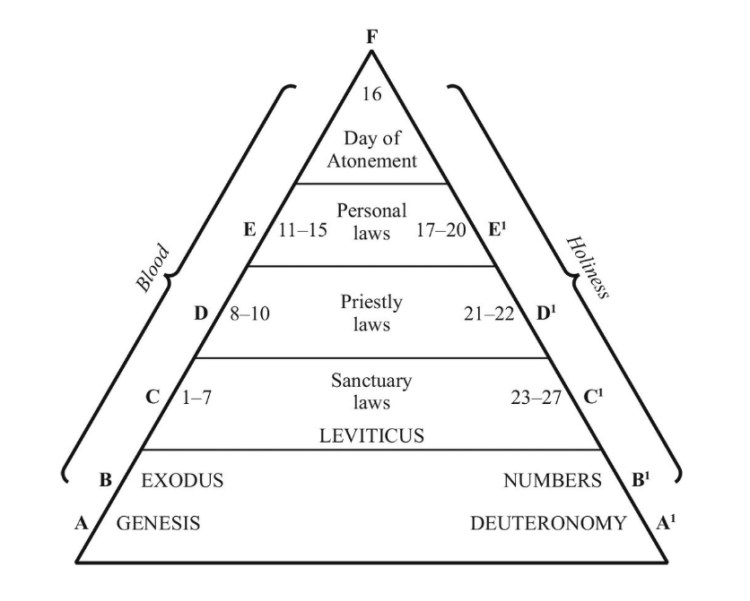
“How the Day of Atonement relates to the theme of Yahweh’s opening a way for humanity to dwell in the divine Presence is readily recognized when the significance of atonement is understood, namely, that it makes possible life in the divine Presence. Atonement is reconciliation, at-one-ment. . . In bringing the divine Presence near, the book of Leviticus itself sharpens the focus of what may be called the central theological dilemma (and drama) of humanity’s relationship to God, namely the danger posed by intimacy with a ‘consuming fire.’“
–L. Michael Morales, Who Shall Ascend the Mountain of the Lord?
Moses and the Greater Moses

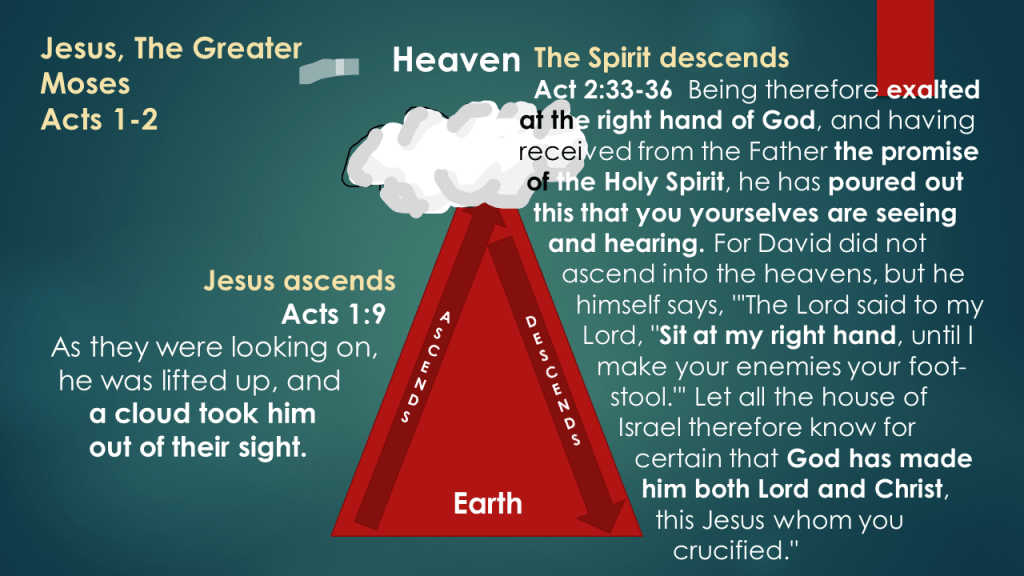
“Let’s be honest: the ascension of Jesus is weird. . . . It is the story of a man who appears to be taken up into the clouds. . . . [But] the ascension is good news. In fact, there could be no salvation and no mission without the ascension. . . . The ascension is the beginning of mission.”
–Tim Chester & Jonny Woodrow, The Ascension: Humanity in the Presence of God (2013)
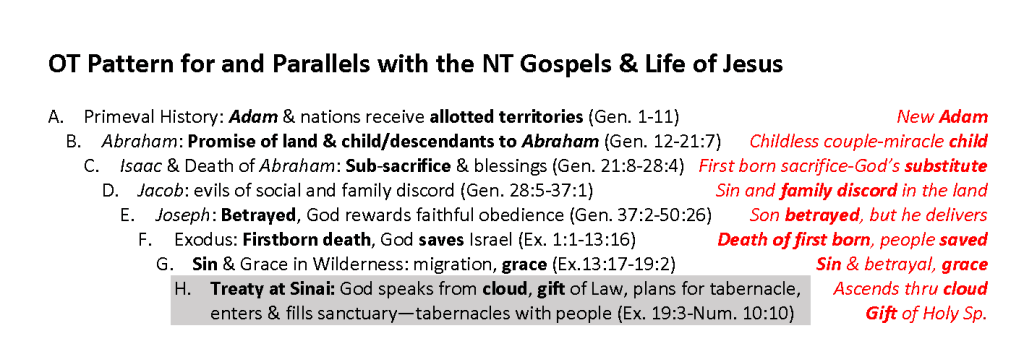
3. OT Pattern for & Parallels with the NT Gospels & Life of Jesus
Following the covenantal structure of Genesis-Joshua according to David Dorsey, Literary Structure of the Old Testament, 1999, p. 101
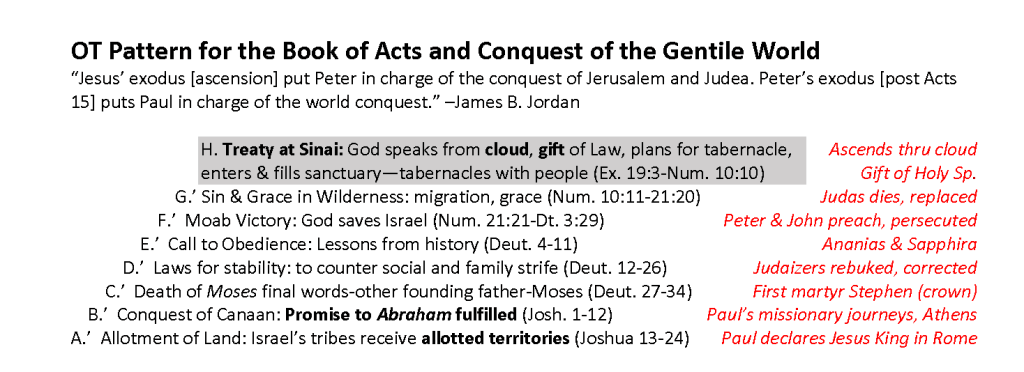
4. OT Pattern for the Book of Acts & the Conquest of the Gentile World
Following the covenantal structure of Genesis-Joshua according to David Dorsey, Literary Structure of the Old Testament, 1999, p. 101
5. OT Types & NT Antitypes for the Conquest of the World:
Egypt-Wilderness-Promised Land to Judea-Samaria-End of the Earth
| OT Type | NT Antitype |
|---|---|
| Exodus Egypt | Exodus Israel (New Egypt) |
| Moses | Jesus (Greater Moses) |
| Wanders the wilderness Ascends the Mount, receives gifts (Law, Tabernacle, divine presence) | Wanders Judea, Samaria, wilderness Ascends to Heaven, gives gifts (Holy Spirit-personal divine presence, gifts*) |
| Aaron (speaks on behalf of Moses) | Peter (Greater Aaron; speaks on behalf of Jesus in Judea, Samaria, initiates Gentile contacts) |
| Moses/God commissions Joshua | Jesus (Greater Moses)/Ananias commissions Saul-Paul |
| Deut. 34:9: “And Joshua the son of Nun was full of the spirit of wisdom, for Moses had laid his hands on him . . . ;” Joshua 1:2: “Moses my servant is dead. Now therefore, go over this Jordan, . . . into the land that I am giving to them, to the people of Israel.” | Acts 9:5-15: “‘Who are you, Lord?’ And he said, ‘I am Jesus, whom you are persecuting. But rise and enter the city, and you will be told what you are to do.’ . . . The Lord said [to Ananias] . . . ‘He [Paul] is a chosen instrument of mine to carry my name before the Gentiles and kings and the children of Israel.”‘ |
| Conquering Promised Land | Conquering the Gentile World |
| Joshua (leads Israel into Canaan) | Paul (Greater Joshua; leads the Church into the world) |
| Joshua 1:5-6: “No man shall be able to stand before you all the days of your life. Just as I was with Moses, so I will be with you. I will not leave you or forsake you. Be strong and courageous, for you shall cause this people to inherit the land that I swore to their fathers to give them.” | Acts 28:30-31: “He lived there two whole years at his own expense, and welcomed all who came to him, proclaiming the kingdom of God and teaching about the Lord Jesus Christ with all boldness and without hindrance.” |
*”But grace was given to each one of us according to the measure of Christ’s gift. Therefore it says, ‘When he ascended on high he led a host of captives, and he gave gifts to men.’ In saying, ‘He ascended,’ what does it mean but that he had also descended into the lower regions, the earth? He who descended is the one who also ascended far above all the heavens, that he might fill all things.) And he gave the apostles, the prophets, the evangelists, the shepherds and teachers, to equip the saints for the work of ministry, for building up the body of Christ, until we all attain to the unity of the faith and of the knowledge of the Son of God, to mature manhood, to the measure of the stature of the fullness of Christ . . . .”
–Ephesians 4:6–16 ESV
“Joshua is a book of warfare, but it is not like other ancient books that describe war. . . . The book of Joshua describes little about actual warfare, and in Joshua, Israel doesn’t win because her army has great warriors. Instead, what is important is to trust in God, who is the Warrior of Israel. The goal of the conquest is to set up God’s house in the land and to worship Him, and even the battles sometimes look more like a service of worship. . . . Everything in the battle of Jericho is organized by sevens. Jericho falls on a Sabbath day, the last day of the week of the siege. The battle of Jericho sends a clear message: When Israel worships God, He brings down walls. . . . . Once the land is consecrated to the Lord by worship, eventually the land will be conquered. It may take centuries, but the Lord will establish His house in the land.”
–Peter Leithart, A House for My Name
“I believe that not only does the book of Acts show us how the Church came into being, but it also shows us how the Church will continue to advance. Each time there was a “death & resurrection” experience, the Church emerged stronger, coming out of “Egypt ” with spoils. Jesus’ death and resurrection led to the conquest of Jerusalem. Peter’s imprisonment and resurrection led to Paul’s gentile conquests. Paul’s imprisonment and resurrection, connected with the events of A.D. 70, led to the birth of the Church into the world . . . . Since that time, whenever the Church has been attacked and put to death, she emerges stronger than before. The blood of the martyrs is always the seed of the Church. The suffering of believers always works to the advancement of the gospel.”
–James B. Jordan
Parallels and Chiasms between Luke and Acts


 Ascended King
You must be logged in to post a comment.