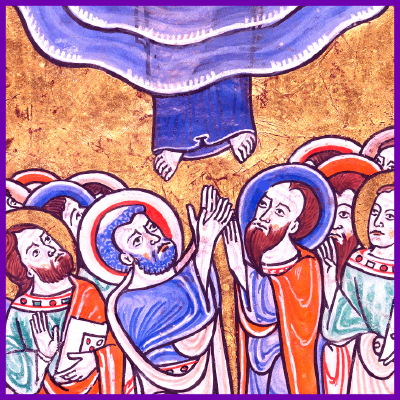
Luke shows similarities and parallels in the lives and work of the Apostles Simon-Peter and Saul-Paul in Acts.
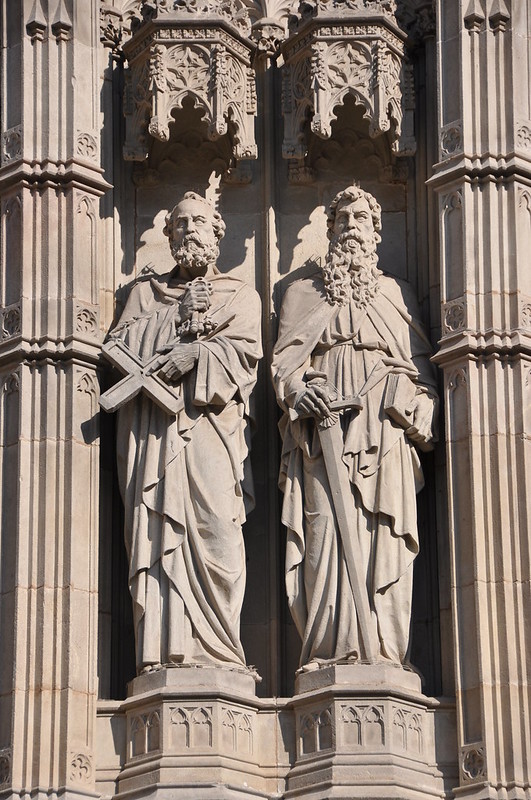
Saints Peter and Paul. 1887-1890. Agapit Vallmitjana, sculptor
Audio Presentation (Roy Atwood, Sunday School, Trinity Reformed Church, Oct. 18, 2020)
Luke reveals how Peter and Paul are like their teacher, Jesus. He also shows how Paul, the last of the apostles, is very similar to the first, Peter. Those similarities highlighted by Luke echo the transfer of authority and scope seen when Joshua takes over the leadership of Israel from Moses (which we discussed earlier), and when Elisha expands the prophetic work of Elijah, as described in 2 Kings 2:4-14.
So they came to Jericho. The sons of the prophets who were at Jericho drew near to Elisha and said to him, “Do you know that today the LORD will take away your master from over you?” And he answered, “Yes, I know it; keep quiet.”
Then Elijah said to him, “Please stay here, for the LORD has sent me to the Jordan.” But he said, “As the LORD lives, and as you yourself live, I will not leave you.” So the two of them went on. Fifty men of the sons of the prophets also went and stood at some distance from them, as they both were standing by the Jordan. Then Elijah took his cloak and rolled it up and struck the water, and the water was parted to the one side and to the other, till the two of them could go over on dry ground.
When they had crossed, Elijah said to Elisha, “Ask what I shall do for you, before I am taken from you.” And Elisha said, “Please let there be a double portion of your spirit on me.” And he said, “You have asked a hard thing; yet, if you see me as I am being taken from you, it shall be so for you, but if you do not see me, it shall not be so.” And as they still went on and talked, behold, chariots of fire and horses of fire separated the two of them. And Elijah went up by a whirlwind into heaven. And Elisha saw it and he cried, “My father, my father! The chariots of Israel and its horsemen!” And he saw him no more.
Then he took hold of his own clothes and tore them in two pieces. And he took up the cloak of Elijah that had fallen from him and went back and stood on the bank of the Jordan. Then he took the cloak of Elijah that had fallen from him and struck the water, saying, “Where is the LORD, the God of Elijah?” And when he had struck the water, the water was parted to the one side and to the other, and Elisha went over.
2 Kings 2:5-14
Elijah’s departure is similar to the death of Moses. Both men remained outside the Land to the east when they departed the earth. Both men passed on their gifts and authority to another: Moses to Joshua (Num. 27:15-23), Elijah to Elisha (2 Kings 2:1-14f). As Joshua received the “spirit of wisdom” when Moses laid hands on him (Deut. 34:9), so Elisha received a “double portion” (the portion received by the firstborn in Israel) of Elijah’s spirit (2 Kings 2:9). This doubled sharing of the spirit allowed Elisha to perform miracles even greater than those Elijah performed. Most importantly, it allowed him to engage in a conquest of mercy. Saul-Paul’s prophetic conquest of the Gentiles was not only greater than Peter’s, but it was also a conquest of mercy, unlike the failed bloody conquest attempted by his namesake’s, King Saul.
“If Elijah is a new Moses, Elisha is a new Joshua. He is a servant to Elijah, as Joshua was to Moses. When Elijah leaves in 2 Kings 2, Elisha receives a double portion of his spirit, the portion of the firstborn, and continues Elijah’s ministry. . . . But the conquest of this Joshua is quite different from the first Joshua’s. Elisha’s conquest is mainly a conquest of mercy, not destruction.”
Peter Leithart, A House for My Name (2000, p. 173)
In the context of Acts, the allusions to Joshua (who conquered the Land Moses never entered) and to Elisha (who crossed the Jordan beyond Elijah) anticipate how Paul “takes the cloak” or “mantle” of Peter and exceeds the range and scope of Peter’s work by his missionary journeys westward beyond the Jordan, Jerusalem, Judea, and Samaria, to the far reaches of the ancient Gentile world. His Kingdom-building work extends beyond Israel to the ends of the earth and conquers of greatest empires of the age. By the time of Emperor Constantine the Great, the sign of the Roman Empire is the cross.
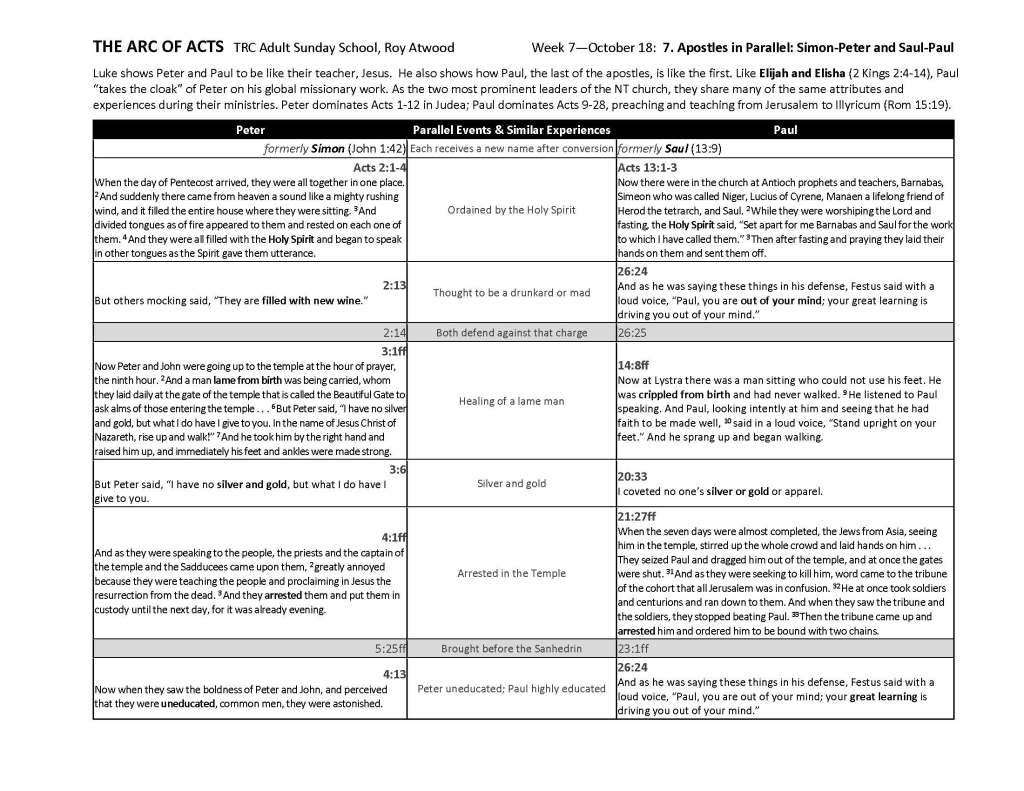
As the two most prominent apostolic leaders of the NT church, Peter and Paul shared many of the same attributes and experiences during their ministries. Peter dominates Acts 1-12 in Judea; Paul dominates Acts 9-28, preaching and teaching from Jerusalem to Illyricum (Rom 15:19). Richard Rackham (1901) identified these parallel events and similar experiences between Peter and Paul highlighted by Luke in his book of Acts (cited by V. Wilson, Divine Symmetries [1997], p. 190; modified slightly below).
| Peter | Parallel Events & Similar Experiences | Paul |
|---|---|---|
| formerly Simon | Each apostle receives a new name after conversion | formerly Saul |
| Acts 2:1-4 | Ordination by the Holy Spirit | Acts 13:1-3 |
| 2:13 | Thought to be a drunkard or mad | 26:24 |
| 2:14 | Both defend against that charge | 26:25 |
| 3:1ff | Healing of a lame man | 14:8ff |
| 3:6 | Silver and gold | 20:33 |
| 4:1ff | Arrest in the Temple | 21:27ff |
| 5:25ff | Brought before the Sanhedrin | 23:1ff |
| 4:13 | Peter uneducated; Paul highly educated | 26:24 |
| 4:8 | Filled with the Holy Spirit | 13:9 |
| 5:5-11 | Fear & awe on others; Ananias & Saph/Ephs | 19:17 |
| 2:43, 5:12 | Signs and wonders performed | 14:3 |
| 5:15f | Peter’s shadow, Paul’s cloak have power to heal | 19:11-12 |
| 5:17 | Success incurs jealousy of the Jews | 13:45 |
| 5:34-39 | Gamaliel and Gallio as steadying influences | 18:14-17 |
| 5:40 | Beaten by the authorities | 16:22 |
| 6:6 | Peter ordains deacons; Paul ordains elders | 14:23 |
| 8:17 | Laying on hands brings gift of the Holy Spirit | 19:6 |
| 10:46 | Speaking in tongues | 19:6 |
| 8:20f | Peter denounces Simon Magus; Paul Bar-Jesus | 13:9f |
| 9:33f | Aeneas-healings on sick bed-Publius’ father | 28:8 |
| 9:36-40 | Dorcas-raised from the dead-Eutychus | 20:9f |
| 10:44f | Cornelius-first Gentile hearers are Roman officials-Sergius Paulus | 10:7f |
| 10:1f | Cornelius-two stories of Roman centurions and Caesarea-Julius | 27:1f |
| 10:9f | Conviction moment: noon/trance, vision, 3x heavenly voice | 9:3f |
| 10:9f, 28; 11:5 | Above story recounted 3 times | 9:1f; 22:6f; 26:12f |
| 10:25 | Cornelius & the Lycaonians worship Peter & Paul | 14:13 |
| 11:3 | Both apostles criticized by circumcision party | 15:1f |
| 5:17f; 12:1f | Imprisoned for the gospel | 16:19f; 21:33ff |
Here’s an expanded handout version of the chart above (in jpeg format) with selected Scripture texts included.

Recommended Readings
David A. Dorsey, The Literary Structure of the Old Testament: A Commentary on Genesis-Malachi (Baker Academic, 1999)
James B. Jordan, Through New Eyes: Developing a Biblical View of the World (Wipf and Stock Publishers, 1999)
Peter J. Leithart, A House for My Name: A Survey of the Old Testament (Canon Press, 2000)
Victor M. Wilson, Divine Symmetries: The Art of Biblical Rhetoric (1997)
“Recovering the Old Testament as a text in which Christians live and move and have their being is one of the most urgent tasks before the church. Reading the Reformers is good and right. Christian political activism has its place. Even at their best, however, these can only bruise the heel of a world that has abandoned God. But the Bible–the Bible is a sword to divide joints from marrow, a weapon to crush the head.”
Peter Leithart, The Kingdom and the Power
 Ascended King
You must be logged in to post a comment.