Review: Highlights from Previous Lessons
- Everywhere we look in creation, stunning complexities and structures abound. If God’s breath spoke all that glory and wonder into being by His Word, how much more should we see glories and wonders in His Word itself. If we have eyes to see, its complexities and structures will take our breath away. Acts and its companion volume, Luke, are breathtaking.
- “Every text depends for its meaning on information lying outside the text. Every text is a joke, and . . . means the way jokes mean. Or, to put it more sharply, the text is a joke” (Leithart, Deep Exegesis). The OT speaks of Christ through its types and shadows. The NT constantly reflects Christ in word and structure.
- Acts is the NT story of the conquest of the Gentiles, reflecting the OT conquest of the Promised (Gentile) Land (Gen. 1-Joshua 24), centered on the Treaty at Sinai (Ex. 19-Num. 10), where God promises to dwell/tabernacle among his people. The NT conquest of the Gentile world follows the same pattern and centers on Christ’s sending the Holy Spirit to dwell in his people.
- The Apostle Paul’s prominence in Acts and the NT is (a) linked to his (Saul of Tarsus) namesake and fellow member of the tribe of Benjamin, King Saul, who lost his kingdom because he failed to conquer the Gentiles, as God commanded. Paul becomes a servant-herald of King Jesus who conquers the Gentile world, and (b) becomes an example for us, because he reflects Christ his savior-king by his life and service.
- The structure of Luke’s two companion volumes, Luke-Acts, is more than mere chronology. They contain obvious parallelisms (A-B//A-B) and clear chiasms (A-B//B-A), both within each book and between both books. In these structural indicators, Luke intended for us to see how the apostles shared Christ’s authority as “sheliak” ([Heb.]//Abraham’s servant, Gen. 24:1-28) and how they and the early church shared and reflected Christ’s experiences of trials and blessings for the sake of His Kingdom.
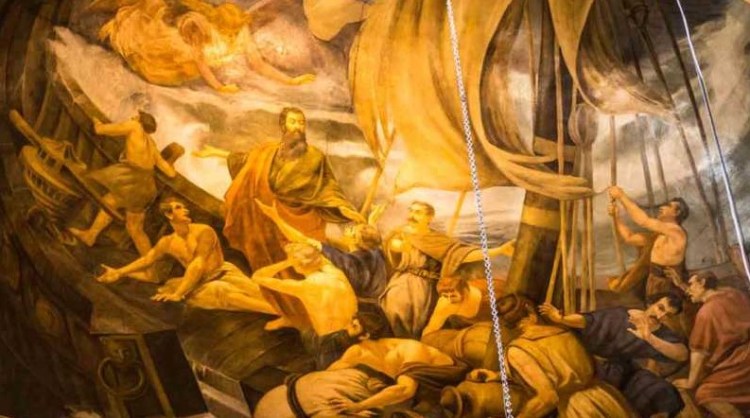
Luke’s Accounts of the Travels of Jesus & Paul
Luke offers few details about the locations (“a village”) of Jesus’s travels toward Jerusalem in his Gospel, but he is quite specific about Paul’s visits during his three missionary journeys. But Jesus’s example sets the tone and context for the greater mission of the church. For example, Jews traveling from Capernaum to Jerusalem would have avoided the Samaritan districts. Yet when Jesus “sets his face to go to Jerusalem,” his path took him directly into Samaria. Jews hated the Samaritans because they embodied God’s righteous judgment against his chosen people for their gross unbelief. God sent the unfaithful Jews into exile and had the King of Assyria displace them from Samaria with immigrants from Babylon (2 Kgs 17:19-41). Jesus goes into this “Gentile” quarter en route to Jerusalem, the city of the King of Peace, whose still-unfaithful leaders—allied with their Gentile/Roman military occupiers—will kill crucify him.
Luke recounts how Paul’s missionary treks begin, like Jesus’s, near his home territory (Antioch of Syria is only 86 miles from Paul’s native Tarsus). Antioch would become one of the great Christian cities in the early church before the Nicaea Council 325 A.D (along with Rome, Alexandria, and Jerusalem). His first missionary journey starts there and is his shortest, reaching only a few hundred miles into southern “Asia” (Minor) or today’s Turkey. His second missionary trip “begins” in Jerusalem after the first great church council, but actually launches from Antioch again. This journey is far longer, going all the way to the Balkans or more than 1,000 miles. His third and final missionary trip covers much of the same territory as his second journey, but takes several years rather than months. He is beaten, jailed, the focus of riots, etc. Still, Paul engages Jews and Sadducees, Romans and people from all over the empire with the message of the gospel. Everywhere he goes, he preaches and teaches, encouraging the saints and challenging opponents, nurturing immature believers and rebuking those who should know the Scriptures and mind of Christ more clearly. He extends Jesus’s missionary mandate to “the ends of the earth.” He thus fulfills King Saul’s command to conquer the Gentile world, not with the sword, but with the gospel, establishing Christ’s kingdom around the world.
During both Jesus and Paul’s extensive travels, Luke records no detailed travelogue, but highlights their teaching and engagement with their many and varied audiences. In Acts Luke shows how Paul’s life and work clearly reflect, even mimic, Christ’s own.
Luke-Acts models the narrative of a great teacher whose life is emulated by his followers. The structure has a deep cultural and literary heritage in the ancient world. . . . The literary Paul is modeled after the literary Christ. Since the Christian no longer lives for him or herself, the goal of life become that of patterning one’s existence after the model of Christ. This is Paul’s stated goal in his own letters and the model he proposes for other Christians to follow
Victor Wilson, Divine Symmetries (1997), p. 189
(Gal. 3:1-5; 4:12-14; 2 Cor. 4:10-11).
| Luke | Journeys in Parallel: Jesus & Paul* | Acts |
|---|---|---|
| Jesus | Journey Narratives | Paul |
| 9:51-53 When the days drew near for him to be taken up, he set his face to go to Jerusalem.And he sent messengers ahead of him, who went and entered a village of the Samaritans, to make preparations for him. But the people did not receive him, because his face was set toward Jerusalem. | A resolve to journey to Jerusalem | 19:21 Now after these events Paul resolved in the Spirit to pass through Macedonia and Achaia and go to Jerusalem, saying, “After I have been there, I must also see Rome.” |
| 9:51-19:27 9:51: When the days drew near for him to be taken up, he set his face to go to Jerusalem. 9:52 Entered a Samaritan village, but they don’t receive him 10:1 After this the Lord appointed 72 others and sent them on ahead of him, two by two, into every town and place where he himself was about to go. 10:38 Now as they went on their way, Jesus entered a village. And a woman named Martha welcomed him into her house. 13:10 Now he was teaching in one of the synagogues on the Sabbath. 13:22 He went on his way through towns and villages, teaching and journeying toward Jerusalem. 17:11-12 On the way to Jerusalem he was passing along between Samaria and Galilee. And as he entered a village, he was met by ten lepers . . . . 18:35 As he drew near to Jericho, a blind man was sitting by the roadside begging. 19:1-2 He entered Jericho and was passing through. And there was a man named Zacchaeus, a chief tax collector and rich. 19:11 As they heard these things, he proceeded to tell a parable, because he was near to Jerusalem, and because they supposed that the kingdom of God was to appear immediately 19:28-30 And when he had said these things, he went on ahead, going up to Jerusalem. When he drew near to Bethphage and Bethany, at the mount that is called Olivet, he sent two of the disciples, saying, “Go into the village in front of you, where on entering you will find a colt tied, on which no one has ever yet sat. . | Missionary journey narratives | 13:1-21:17 First Missionary Journey (13, 14) From Antioch (Syria) to the regions of Cyprus, Pamphylia, Pisidia, Phrygia, and Galatia, and the cities of Attalia, Antioch of Pisidia, Derbe, Lystra, Iconium, and Perga, all in modern Turkey, before returning to Antioch and on to the Jerusalem Council to address conflicts over circumcision, eating meat offered to idols, and sexual sin (15:6-29). 13:4-6 So, being sent out by the Holy Spirit, they went down to Seleucia, and from there they sailed to Cyprus. When they arrived at Salamis, they proclaimed the word of God in the synagogues of the Jews. And they had John to assist them. When they had gone through the whole island as far as Paphos, they came upon a certain magician, a Jewish false prophet. Second Missionary Journey (15:39-18:22) After the Jerusalem Council, Paul, Silas & Timothy go back to the churches in Phrygia and Galatia. They are blocked from going onto Asia and receive a call to go to Macedonia and Greece. On this journey, the Philippian jailer is saved and Paul presents the gospel to the Greek philosophers at the Areopagus in Athens. 16:6-10 And they went through the region of Phrygia and Galatia, having been forbidden by the Holy Spirit to speak the word in Asia. And when they had come up to Mysia, they attempted to go into Bithynia, but the Spirit of Jesus did not allow them. . . . And a vision appeared to Paul in the night: a man of Macedonia was standing there, urging him and saying, “Come over to Macedonia and help us.” And . . . immediately we sought to go on into Macedonia. Third Missionary Journey (18:23-21:16) Paul revisits the Galatian churches, stayed in Ephesus for 2 years, where he faced a riot, revisits Macedonia and Greece for 3 months before returning via Tyre to Jerusalem. 18:23 After spending some time there, he departed and went from one place to the next through the region of Galatia and Phrygia, strengthening all the disciples. 19:21-22 Now after these events Paul resolved in the Spirit to pass through Macedonia and Achaia and go to Jerusalem, saying, “After I have been there, I must also see Rome.” And having sent into Macedonia two of his helpers, Timothy and Erastus, he himself stayed in Asia for a while. |
| 9:31, 51; 12:50; 13:33; 18:31-33 | Passion journey | 20:3, 22-24, 37-38; 21:4, 12-13 |
| 9:45 But they did not understand this saying, and it was concealed from them, so that they might not perceive it. And they were afraid to ask him about this saying. 18:34 But they understood none of these things. This saying was hidden from them, and they did not grasp what was said. | Friends and disciples lack understanding | 21:4, 12-13 4 And having sought out the disciples, we stayed there for seven days. And through the Spirit they were telling Paul not to go on to Jerusalem. . . . When we heard this, we and the people there urged him not to go up to Jerusalem. Then Paul answered, “What are you doing, weeping and breaking my heart? For I am ready not only to be imprisoned but even to die in Jerusalem for the name of the Lord Jesus.” |
| 13:31-34 And he said to them, “Go and tell that fox, ‘Behold, I cast out demons and perform cures today and tomorrow, and the third day I finish my course. Nevertheless, I must go on my way today and tomorrow and the day following, for it cannot be that a prophet should perish away from Jerusalem.’ O Jerusalem, Jerusalem, the city that kills the prophets and stones those who are sent to it! | Ready to die in Jerusalem | 21:13 “For I am ready not only to be imprisoned but even to die in Jerusalem for the name of the Lord Jesus.” |
| Arrest & Trial | ||
| 19:37 As he was drawing near—already on the way down the Mount of Olives—the whole multitude of his disciples began to rejoice and praise God with a loud voice for all the mighty works that they had seen, saying, “Blessed is the King who comes in the name of the Lord! Peace in heaven and glory in the highest!” And some of the Pharisees in the crowd said to him, “Teacher, rebuke your disciples.” He answered, “I tell you, if these were silent, the very stones would cry out.” | Joyously received on arrival in Jerusalem | 21:17-20 When we had come to Jerusalem, the brothers received us gladly. On the following day Paul went in with us to James, and all the elders were present. After greeting them, he related one by one the things that God had done among the Gentiles through his ministry. And when they heard it, they glorified God. |
| 19:47-48 And he was teaching daily in the temple. The chief priests and the scribes and the principal men of the people were seeking to destroy him, but they did not find anything they could do, for all the people were hanging on his words. | A visit to the Temple; friendly attitude | 21:26 Then Paul took the men, and the next day he purified himself along with them and went into the temple, giving notice when the days of purification would be fulfilled and the offering presented for each one of them. |
| 20:27-39 There came to him some Sadducees, those who deny that there is a resurrection, and they asked him a question . . . And Jesus said to them, “The sons of this age marry and are given in marriage, but those who are considered worthy to attain to that age and to the resurrection from the dead neither marry nor are given in marriage, for they cannot die anymore, because they are equal to angels and are sons of God, being sons of the resurrection. | Dispute over the resurrection; Sadducees v. Pharisees | 23:6-9 Now when Paul perceived that one part were Sadducees and the other Pharisees, he cried out in the council, “Brothers, I am a Pharisee, a son of Pharisees. It is with respect to the hope and the resurrection of the dead that I am on trial.” And when he had said this, a dissension arose between the Pharisees and the Sadducees, and the assembly was divided. For the Sadducees say that there is no resurrection, nor angel, nor spirit, but the Pharisees acknowledge them all. |
| 22:14-38 And when the hour came, he reclined at table, and the apostles with him. And he said to them, “I have earnestly desired to eat this Passover with you before I suffer. . . . “You are those who have stayed with me in my trials, and I assign to you, as my Father assigned to me, a kingdom, that you may eat and drink at my table in my kingdom and sit on thrones judging the twelve tribes of Israel. | Farewell address to intimate friends | 20:17-23 And now, behold, I am going to Jerusalem, constrained by the Spirit, not knowing what will happen to me there, except that the Holy Spirit testifies to me in every city that imprisonment and afflictions await me. |
| 22:14-20 And he took a cup, and when he had given thanks he said, “Take this, and divide it among yourselves. For I tell you that from now on I will not drink of the fruit of the vine until the kingdom of God comes.” And he took bread, and when he had given thanks, he broke it and gave it to them, saying, “This is my body, which is given for you. Do this in remembrance of me.” And likewise the cup after they had eaten, saying, “This cup that is poured out for you is the new covenant in my blood. | Last meal shared in final, early hours | 27:33-38 |
| 22:47-54 | Seizure by a mob | 21:30 |
| 22:63-64 | A slap before the High Priest | 23:2 |
| 22:66; 23:1, 8, 13 | Four trials | 23, 24, 25, 26 |
| 23:4; 23:14, 22 | Three declarations of innocence | 23:9; 25:25; 26:31 |
| 23:6-12 | Sent to King Herod/Agrippa for questioning | 25:13-26:32 |
| 23:16, 22 | An opportunity for release | 26:32 |
| 23:18 | Jews cry, “Away with this man/him” | 21:36 |
| 23:47 | A centurion has a favorable opinion | 27:3, 43 |
| 24:46-49 | “To all the nations”/ “To the Gentiles” | 28:28 |
Paul visited Thessaloniki at least twice in his missionary journeys. These Roman-era ruins include a basilica (later a Christian church), Caesar Galerius’s palace, and the ancient archway into the Roman district of the city.
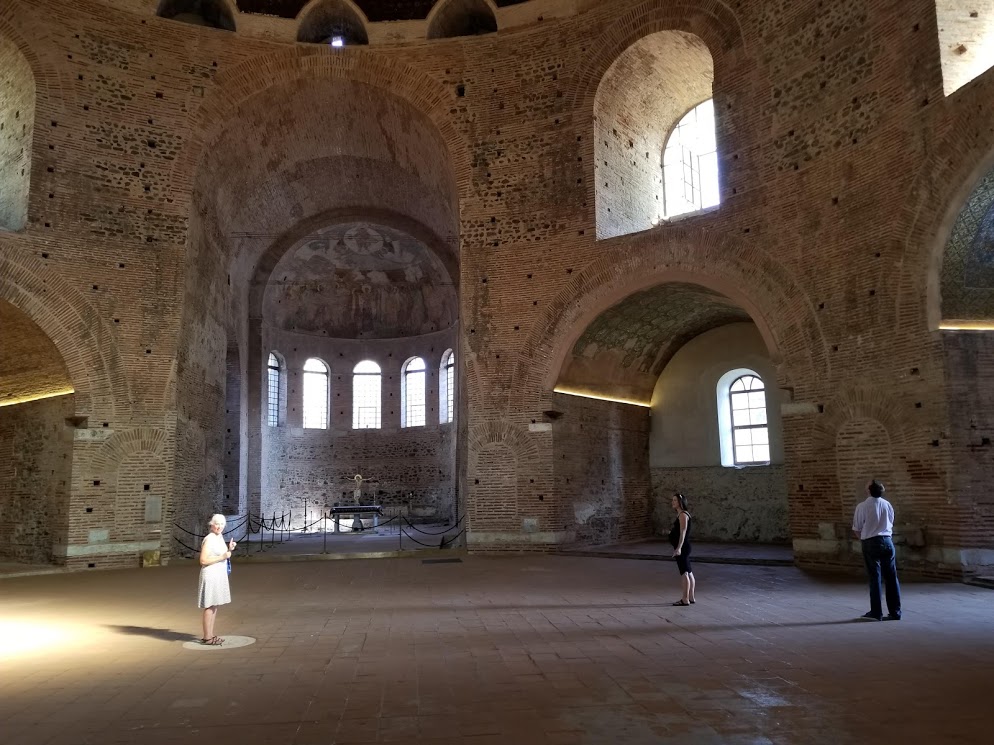
(Photo R. Atwood, 2018)
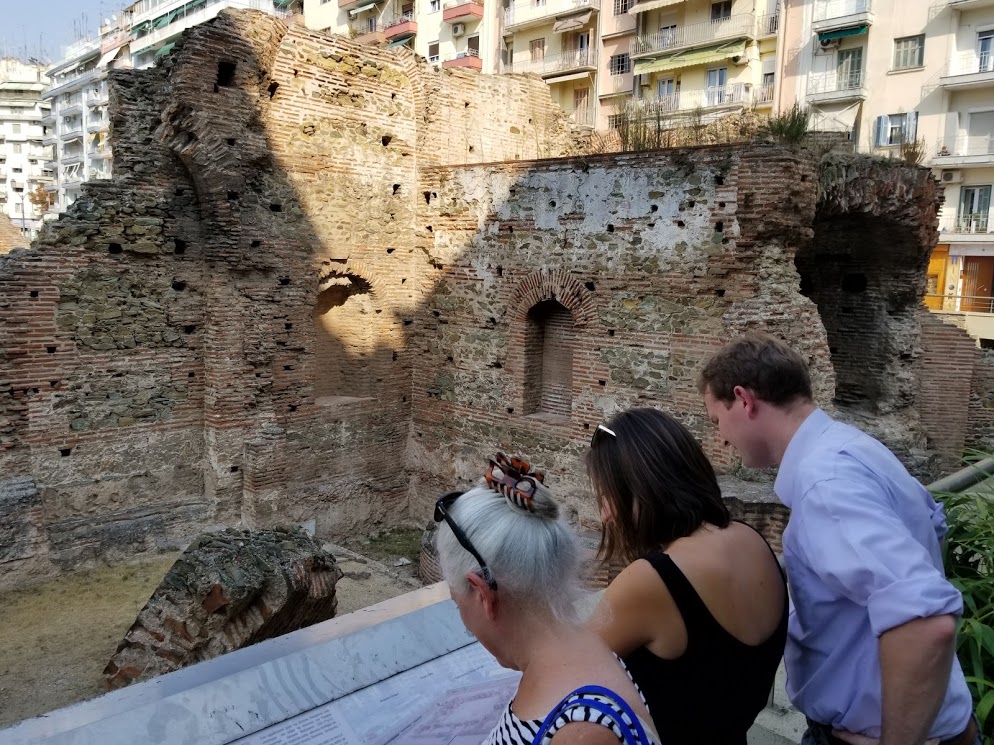
Circa late 3rd century-early 4th century A.D., built by Caesar Galerius Valerianus Maximianus (260-311),
of Illyrian descent. He chose Thessaloniki as the seat of the eastern Empire (later moved to Constantinople by Emperior Constantine).
(Photo R.Atwood, 2018)

(Photo R.Atwood, 2018)
Recommended Readings
James B. Jordan, Through New Eyes: Developing a Biblical View of the World (Wipf and Stock Publishers, 1999)
Peter J. Leithart, Deep Exegesis: The Mystery of Reading Scripture (Baylor University Press, 2009)
Peter J. Leithart, A House for My Name: A Survey of the Old Testament (Canon Press, 2000)
David A. Dorsey, The Literary Structure of the Old Testament: A Commentary on Genesis-Malachi (Baker Academic, 1999)
Victor Wilson, Divine Symmetries (University Press of America, 1997)
Parallels and Chiasms between Luke and Acts


“[E]very reader, no matter how literal-minded and scientific, no matter how committed to exegesis or hostile to eisegesis, is pouring stuff into the text that is not there, or, perhaps more accurately, siphoning off stuff that is not there. . . . Even the most rigorously grammatical and historical exegesis of the Bible depends on connections between text and text, or text and speech, or text and extratextual reality.”
Peter Leithart, Deep Exegesis
 Ascended King
You must be logged in to post a comment.