“Continue in what you have learned and have firmly believed, knowing from whom you learned it and how from childhood you have been acquainted with the sacred writings, which are able to make you wise for salvation through faith in Christ Jesus. All Scripture is breathed out by God and profitable for teaching, for reproof, for correction, and for training in righteousness, that the man of God may be complete, equipped for every good work.”
II Timothy 3:14-16
Reading Scripture well requires giving close attention not only to its words, grammar, and historical contexts, but also to the architecture of the text in whole-and-part: the author’s word choices, the text’s structure, it’s organization, typologies, tropes, allusions, and quotations from elsewhere (some from other Scriptures, and extrabiblical sources [e.g., Acts 17:28: Paul quotes Epimenides of Crete and Aratus’s poem “Phainomena” ]). We need to learn to read like Jesus and Paul, and how the other biblical writers read and interpreted the Old Testament. And most importantly, we need to let God’s Word shape and reshape us in His image, giving us new eyes and ears, new hearts, new lives.
If creation, in all its complexities and interrelationships, reflects the glory and attributes of God, how much more His very own Word. The Bible is not randomly expressed or lacking depth and breadth of structure. It is not an ancient text that only scholars and scientists can peal back the layers of meaning. As James Jordan right points out, “God doesn’t waste his breath.” Everything–everything–in the Bible is meaningful.
Structure and Meaning Everywhere in Creation:
From Sub-Atomic Particles to the Farthest Galaxies
Everywhere you look in creation, stunning complexities abound. No matter how deeply you probe with a microscopic or how far out you look to the limits of our telescopes, there are complex structures everywhere across time and space. If God’s Word spoke all that glory into being, how much more should we see more than just black ink on a white page, but such glories and wonders in the Word itself that simply take our breath away? Do you have eyes to see and hears to hear?
Reading Scripture with New Eyes:
Through New Eyes (Jordan), Deep Exegesis (Leithart)
[Deep Exegesis, p. 116] “[E]very reader, no matter how literal-minded and scientific, no matter how committed to exegesis or hostile to eisegesis, is pouring stuff into the text that is not there, or, perhaps more accurately, siphoning off stuff that is not there. . . . Even the most rigorously grammatical and historical exegesis of the Bible depends on connections between text and text, or text and speech, or text and extratextual reality.”
[p. 117] “Everyone brings information to the text that is not in the text and seeks to illuminate the text with light from outside. They fill in the gaps between words and sentences to produce a whole picture. That is perfectly fine and, I have been arguing, inescapable. What is not fine is the pretense that literal reading does not involve this process, the claim that a reading is doing nothing but getting what is there.”
If creation, in all its complexities and interrelationships, reflects the glory and attributes of God, how much more His very own Word. The Bible is not randomly expressed or lacking depth and breadth of structure. It is not an ancient text that only scholars and scientists can peal back the layers of meaning. As James Jordan right points out, “God doesn’t waste his breath.” Everything–everything–in the Bible is meaningful. We have to stop reading it like it is a phone book or encyclopedia, or recipe book, and start looking for how the Bible itself provides the means to interpret God’s Word in all its glory, not just in the data it downloads
Structure & Meaning Everywhere in God’s Word:
Parallelisms & Chiasms from Genesis to Revelation
The Structure of Creation Week (Gen. 1-3) The Structure of the Human Week (Exodus 20:8-11)
| 8 “Remember the Sabbath day, to keep it holy. 9 Six days you shall labor, and do all your work, 10 but the seventh day is a Sabbath to the Lord your God. On it you shall not do any work, you, or your son, or your daughter, your male servant, or your female servant, or your livestock, or the sojourner who is within your gates. 11 For in six days the Lord made heaven and earth, the sea, and all that is in them, and rested on the seventh day. Therefore, the Lord blessed the Sabbath day and made it holy. |
Dividing Filling
Day 1: Light/dark Day 4: Sun, moon, stars
Day 2: Waters above/below Day 5: Birds and fish
Day 3: Waters/land Day 6: Land animals and man
Day 7: Sabbath Rest
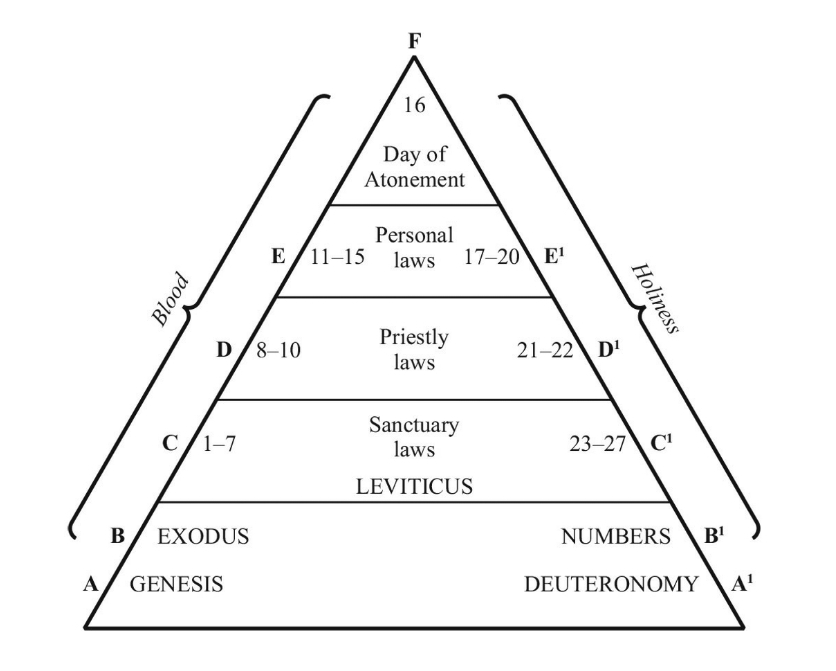
The Structure of the Pentateuch (First Five Books of the Bible)
Parallelisms:
Psalm 19:1-2
A. The heavens A. Day to day
B. declare B. pours out
C. the glory of God, and C. speech, and
A’. the sky above A’. night to night
B’. proclaims B’. reveals
C’. his handiwork C’. knowledge
Chiasms:
Genesis 11:1-9
A. The whole earth has one language (v. 1)
B. Settled there (v. 2)
C. Said to one another (v. 3)
D. Come, let us make bricks (v. 3)
E. Let us build (v. 4)
F. City and tower (v. 4)
G. Lord came down (v. 5)
F’. City and tower (v. 5)
E’. That man built (v. 5)
D’. Come, let us confuse (v. 7)
C’. One another’s speech (v. 7)
B’. Scattered from there (v. 8)
A’. Confused language of the whole earth (v. 9)
The Glories of Scripture:
From Texts to Jokes—Typologies, Allegories (Gal. 4) & Poems
Typology: “Refers to an image impressed onto something else, for instance, wax. It is the word used in Scripture for the imprint of God’s heavenly pattern on the earth . . . . In Acts 7:44 Stephen says, ‘Our fathers had the Tabernacle of Testimony in the wilderness, just as He who spoke to Moses directed him to make it according to the pattern [type] which he had seen.’ Similarly, Hebrews 8:5, quoting Exodus 25:40, reminds us that Moses was told, ‘See that you make all things according to the pattern [type] which was shown you on the mountain.”
–Mike Bull, The Bible Matrix: An Introduction to the DNA of the Scriptures (West Bow Press, 2010), p. 20
See Hos. 11:1 and Mt. 2:15.
Tropes: Culturally recognized commonplace figures of speech which move beyond a literal meaning of a text (or symbol) to a figurative meaning. “Stop and smell the roses,” “Knock yourself out,” “It’s all Greek to me,” or in cinema, black hats (villains dress in black, good guys in white), capes (superhero [played contra in The Incredibles]) are examples of tropes you’ll find across literature and pop culture. [Leithart, “Shrek is impenetrable unless the viewer comes armed with a cache of nursery rhymes, fairy tales, and recollections from pop culture,” Deep Exegesis, p. 115]
Leithart on the Hermeneutics of Humor: Jokes
[Deep Exegesis, p. 113] “A priest, a rabbi, a nun, a doctor, and a lawyer all walk into a bar. The bartender says, ‘What is this, a joke?’”
“. . . [This joke] was puzzling to my children. . . . They knew all the words, grasped the syntax of the sentence. But they did not get it. The joke depends on a confluence of two joke traditions; jokes about diverse religious figures or professionals on the one hand, and jokes about barroom conversations on the other. . . .
[p. 115] Like [all jokes], every text depends for its meaning on information lying outside the text. Every text is a joke, and a good interpreter is one with a good sense of humor, one with a broad knowledge and the wit to know what bits of knowledge are relevant. All interpretation is a matter of getting it. All texts mean the way jokes mean. Or, to put it more sharply, the text is a joke. [This] is true in the apparently trivial sense that no text defines all its terms for the reader [no could it] . . . .
The Architecture of Scripture:
Luke-Acts, John-Revelation
Parallels between John and Revelation Warren Gage (John-Revelation Project) argues, if the two books are read alongside each other, as the early Church Fathers suggested, they will interpret each other. The parallel chart below illustrates the interrelationship of John’s two books. Word(s) in bold are from the same root in the Greek. Italicized words are terms related thematically, but from different Greek roots.
| THE GOSPEL OF JOHN | THE BOOK OF REVELATION |
| 1:1 John writes concerning “the Word of God“ | 1:2 John witnesses to “the Word of God” |
| 1:5 Jesus is “the Light (that) shines in darkness” | 1:16 The face of Jesus “shines like the sun” |
| 1:14 “We beheld His glory as the only begotten of the Father” | 1:5-6 “Jesus Christ…the firstborn from the dead…to Him be glory“ |
| 1:23 John the Baptist introduces the earthly Jesus: “I am the voice of one crying, ‘In the wilderness’” | 1:10 John the Apostle “heard … a loud voice, as of a trumpet,” and sees the heavenly Jesus. |
| 1:42 Jesus gives Peter a new name: “Cephas, which is translated, ‘a stone’” | 2:17 “To him who overcomes…I (Jesus) will give a white stone, and on the stone a new name” |
| 2:17 Jesus purges the temple: “Zeal for Your house will consume Me” | 3:19 Jesus purifies His church: “Be zealous therefore, and repent” |
| 2:24-25 “Jesus…knew all men…for He Himself knew what was in man“ | 2:23 “all the churches shall know that I (Jesus) am He who searches the minds and hearts“ |
| 3:1,10 “now there was a man of the Pharisees, named Nicodemus…a teacher in Israel” . . . | 2:15 “the teaching of the Nicolaitans” (2:6) . . . |
| 19:19 “Pilate wrote a title…it was written, ‘JESUS OF NAZARETH. THE KING OF THE JEWS.’” | 19:16 “On His outer garment…a name was written, ‘KING OF KINGS AND LORD OF LORDS’” |
| 19:23 “when they crucified Jesus, they took His outer garments“ | 19:16 “On his outer garment…a name was written, ‘KING OF KINGS’” |
| 19:28, 30, 40, 42 “Jesus, knowing that all things were now finished…said, ‘It is finished!’…and they took the body of Jesus and bound it…and placed it in a tomb.” | 20:2, 3, 5 “He laid hold of the dragon…and bound him, and shut him in the abyss…that he should deceive the nations no more until the thousand years were finished…and the rest of the dead did not live again until the thousand years were finished“ |
| 20:15 “Jesus said… ‘Woman, why are you weeping?’” | 21:4 “and He shall wipe away every tear from their eyes” |
| 20:17 “Jesus said to her, ‘Do not hold to me yet, for I have not yet ascended to My Father…to My God and your God.’” | 21: 2 “Then I, John, saw the holy city, New Jerusalem, descending out of heaven from God, prepared as a bride adorned for her husband…” |
| 20:27 “Be not unbelieving but believing” | 21:8 “But the fearful and unbelieving“ |
| 21:15″Feed my lambs“ | 19:9 “the wedding supper of the Lamb“ |
| 21:24 “this is the disciple who…wrote these things; and we know that his witness is true“ | 21:5 “And He said to me, ‘Write, for these words are faithful and true“ |
| 21:25 “And there are many other things that Jesus did, which if they were written one by one, I suppose that even the world itself could not contain the books that would be written.” | 22:18-19 “if anyone takes away from the words of the book of this prophecy, God shall take away his part…from the things which are written in this book.” |
From Warren Gage, The John-Revelation Project
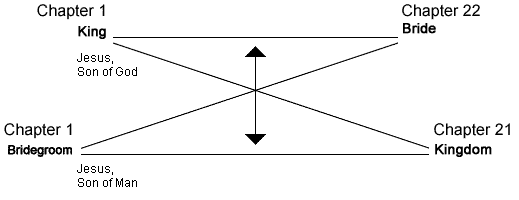
The Architecture of Scripture:
Parallels and Chiasms in Luke-Acts


A Partial List of OT Allusions in Revelation:
Leithart’s Commentary on Revelation (2 Vols.)
| OT Book | Theme | Revelation |
|---|---|---|
| Genesis | Creation, 1 | Sequences of seven, 2–3; 6:1–8:4; 8:6–11:18; 16:1–21 |
| Adam and Eve, 2 | Son of man and bride, 1:13; 21:1–8 | |
| Garden, 2:8 | Paradise of God, 2:7 | |
| Tree of life, 2:9 | Tree of life, 2:7 | |
| Serpent (and Eve), 3:1–7 | Dragon (and woman), 12:1–5; 20:2 | |
| Rainbow, 9:13–16 | Rainbow, 4:3; 10:1 | |
| Babel, 11:1–8 | Babylon, 14:8; 17–18 | |
| Abraham from beyond river, 11–12 | Army from Euphrates, 9:14; cf. 16:12 | |
| Sodom, 18–19 | Sodom, 11:8 | |
| Judah a lion, 49:9 | Lion of Judah, 5:5 | |
| Exodus | I am, 3:14 | I am, 1:8, 17; 22:13, 16 |
| Plagues, 5–11 | Plagues, 15:1 | |
| River to blood, 7:19 | Water to blood, 8:8–9; 11:6; 16:3–4 | |
| Frogs, 8:1–13 | Frogs, 16:13 | |
| Hail, 9:18–35 | Hail, 8:7; 16:21 | |
| Locusts, 10:1–20 | Locusts, 9:1–11 | |
| Passover Lamb, 12 | Lamb, 5:6 | |
| Bitter water, 15:23–25 | Poison water, 8:10–11 | |
| Sea dried up, 14:21–22 | River dried, 16:12 | |
| Song of Moses, 15:1–18 | Song of Moses, 15:1–4 | |
| Manna, 16:1–36 | Manna, 2:17 | |
| Eagle wings, 19:4 | Eagle wings, 12:14 | |
| Kingdom of priests, 19:6 | Kingdom and priests, 1:6; 5:10; 20:6 | |
| Thunder and lightning, 19:16 | Thunder and lightning, 4:5; 8:5; 16:18 | |
| God the Creator, 20:11 | God the Creator, 10:6 | |
| Tabernacle, 25–31 | Spread tabernacle, 7:15; 21:3 | |
| Ark of the covenant, 25:10–22 | Ark of the covenant, 11:19 | |
| Bronze altar, 27:1–8 | Altar, 6:9 | |
| Golden altar, 30:1–10 | Golden altar, 8:3 | |
| Lampstand, 25:31–35 | Seven lampstands, 1:12 | |
| Golden calf, 32 | Image of the Beast, 13 | |
| Tabernacle filled with glory, 40:34–35 | Temple filled with smoke, 15:8 | |
| Leviticus | Blood of sin offering, 4:18, 25 | Souls beneath altar, 6:9–11 |
| Coals and incense, 16:12 | Coals and incense, 8:5 | |
| Burning of priest’s harlot daughter, 21:9 | Burning of Babylon, 17:16 | |
| Lamb with first sheaf, 23:9–12 | Lamb ascended, 5:5 | |
| Priests trim lampstands, 24:1–9 | Jesus among lampstands, 1:13 | |
| Numbers | Balaam and Balak, 22–25 | Balaam and Balak, 2:14 |
| Numbering of tribes, 1; 26 | Numbering of 144,000, 7:1–8 | |
| Jealousy test, 5:1–31 | Eating the book, 10:8–11 | |
| Deuteronomy | Curses, 2 | Trumpets and bowls, 8–11; 16 |
| City of palms, 34:3 | Palm branches, 7:9 | |
| Avenges servants, 32:43 | Avenges saints, 19:2 | |
| Joshua | Joshua with book, 1:8 | Lamb with book, 5:6–7 |
| Fall of Jericho, 6 | Fall of Babylon, 17–18 | |
| Judges | Megiddo, 5:19 | Har-Magedon, 16:16 |
| Samuel | David | Lion of Judah, 5:5 |
| Kings | Pillars in the temple, 1 Kgs 7:15–22 666, 1 Kgs 10:14 | Pillar in temple, 3:12 666, 13:18 |
| Jezebel, 1 Kgs 16–2 Kgs 9 | Jezebel, 2:20 | |
| Shut up sky, 1 Kgs 17:1 | Shut up sky, 11:6 | |
| 7000, 1 Kgs 19:18 | 7000, 11:13 | |
| Fall of Jerusalem, 2 Kgs 25 | Fall of Babylon, 17–18 | |
| Chronicles | 24 chief priests, 1 Chr 24–25 | 24 Ancient Ones, 4:4 |
| Levitical choir, 1 Chr 25:1–31 | Heavenly choir, 4–5; 15:1–4 | |
| Temple filled with glory, 2 Chr 5:14 | Temple filled with smoke, 15:8 | |
| Esther | Feast with gifts, 9:22 | Feast with gift giving, 11:10 |
| Job | Satan the accuser, 1–2 | Satan, 12:9 |
| Psalms | Rule with rod, 2:9 | Rule with rod of iron, 2:27; 12:5 |
| Nations enraged, 2:1–3 | Nations enraged, 11:17 | |
| “How long?” 13:1–2; etc. | How long? 6:10 | |
| Shepherd, 23:1 | Shepherd, 7:17; 19:15 | |
| Firstborn, ruler, 89:27 | Firstborn, ruler, 1:5 | |
| New song, 96:1; etc. | New song, 14:3 | |
| Idols, 115; 135 | Idols, 9:20 | |
| Incense and prayer, 141:2 | Incense and prayer, 8:3 | |
| Hallelujahs, Pss. 146–150 | Hallelujah, 19:1–6 | |
| Proverbs | Lady wisdom and folly, 7–9 | Harlot and Bride, 17; 21 |
| Song of Songs | Wasf of the bridegroom, 5:10–16 | Unveiling of Jesus, 1:12–17 |
| Knocking to enter, 5:2 | Invitation to Laodicea, 3:20–21 | |
| Wasf of bride, 4:1–6; 7:1–9 | False bride, 9:1–11; true bride, 21:9–22:5 | |
| Come to me, 8:14 | Come, Lord Jesus, 22:20 | |
| Isaiah | Pilgrimage of nations, 2:2–4 | Kings bring treasures, 21:24 |
| Holy, Holy, Holy, 6:3 | Holy, Holy, Holy, 4:8 | |
| Seven gifts of Spirit, 11:2 | Seven spirits, 4:5; 5:6 | |
| Rod of mouth, 11:4 | Rod, 19:15Smoke forever, 14:11; 19:3 | |
| Sun darkened, 13:10 | Sun black as sackcloth, 6:12; 8:12 | |
| Fallen star of Babylon, 14:12 | Falling stars, 8:10–11; 9:1–11 | |
| Fallen is Babylon, 21:9 | Fallen is Babylon, 14:8; 18:2 | |
| Keys, 22:22 | Keys, 1:18 | |
| Wipe tears, 25:8 | Wipe tears, 21:4 | |
| Dragon, 27: | Dragon, 12:3 | |
| Sky rolled like scroll, 34:4 | Sky rolled like scroll, 6:14 | |
| Smoke forever, 34:10 | Smoke forever, 14:11; 19:3 | |
| First and last, 41:4; 44:6; 48:12 | First and last, 1:17; 2:8 | |
| Do something new, 43:19 | Make all things new, 21:5 | |
| Queen forever, 47:5 | Queen forever, 18:7 | |
| No hunger, thirst, heat, 49:10 | No hunger, thirst, heat, 7:16 | |
| Second exodus, 40–48 | Come out, 18:4 | |
| Nations walk by Zion’s light, 60:3 | Nations walk by city’s light, 21:24 | |
| Wine press, 63:2 | Wine press, 19:15 | |
| New heaven and earth, 65:17 | New heaven and earth, 21:1 | |
| Jeremiah | Fire from mouth, 5:14 | Fire from mouth, 9:18; 11:5 |
| Wine of wrath, 25:15 | Wine of wrath, 14:10 | |
| Golden cup, 51:7 | Golden cup, 17:4 | |
| Lamentations | Treading wine press, 1:15 | Treading wine press, 14:19–20 |
| Mourning over fallen city, 1:1–22 | Mourning over fallen city, 18 | |
| Ezekiel | Vision of glory, 1–3 | Heavenly liturgy, Rev 4 |
| Cherubim, 1:10 | Living creatures, 4:7 | |
| Rainbow, 1:28 | Rainbow, 4:3 | |
| Eat scroll, 3:1 | Eat book, 10:8–10 | |
| Marking those who mourn, 9 | Sealing the 144,000, 7:1–7 | |
| Harlot Jerusalem, 16; 23 | Harlot Babylon, 17–18 | |
| Tyre’s goods, 27 | Goods of Babylon, 18:11–13 | |
| Restored Eden, 36:33–36 | Holy city, 21:1–22:5 | |
| Resurrection, 37:1–14 | First resurrection, 20:4–5 | |
| Gog and Magog, 38–39 | Post-millennial battle, 20:7–10 | |
| Scavenger birds, 39:17–20 | Scavenger birds, 19:17–18 | |
| Measuring rod, 40:1 | Measuring rod, 11:1; 21:15 | |
| Restored temple and city, 40–48 | Temple-city from heaven, 21–22 | |
| River and tree of life, 47:1–12 | River and tree of life, 22:1–2 | |
| Daniel | Imperial statue, 2:36–45 | Jesus’s bronze feet, 1:15 |
| King of kings, 2:37 | King of kings, 17:14; 19:16 | |
| Head and hair white, 7:9 | Head and hair white, 1:14 | |
| Coming on clouds, 7:13–14 | Coming on clouds, 1:8 | |
| Son of Man, 7:13 | Son of Man, 1:12; 14:14 | |
| Beasts from sea, 7:1–8 | Composite beast from sea, 13:1–2 | |
| Glory, dominion, kingdom, 7:14 | Honor, glory, dominion, 5:13 | |
| Stars fall, 8:10 | Stars fall, 6:13 | |
| Michael, 10:13, 21; 12:1 | Michael, 12:7 | |
| Sealed book, 12:4 | Sealed book, 5:1; 10:4 | |
| Hosea | Courting wayward bride, 1–3 | Wayward bride in wilderness, 17–18 |
| Mountains fall, 10:8 | Mountains fall, 6:16 | |
| Joel | Locusts, 1–2 | Locorpions, 9:1–11 |
| Moon to blood, 2:31 | Moon to blood, 6:12 | |
| Jonah | Sea monster, 2 | Beast from the sea, 13:1–2 |
| Habakkuk | Lord rides out with bow, 3:8–15 | White horse rider with bow, 6:1–2 |
| Zephaniah | Day of Yahweh, 1:14–18 | Great day of God almighty, 16:14 |
| Haggai | Shaking heaven and earth, 2:6–7 | Earthquakes, 6:12; 8:5; 11:13, 19; 16:18 |
| Zechariah | Horses, 1:8–11; 6:1–8 | Four horsemen, 6:1–6 |
| Woman wickedness, 5:5–11 | Harlot city, 17–18 | |
| Joshua and Satan, 3 | Satan and woman, 12:1–6 | |
| Lampstands and trees, 4:1–14 | Two witnesses as lampstands, trees, 11:4 | |
| Conversation with angel, 4:5, 13 | Conversation with angel, 7:13–14 | |
| Tribes mourn, 12:10 | Tribes mourn, 1:7 | |
| Megiddo, 12:11 | Har-Magedon, 16:16 | |
| Holy city, 14:1–21 | Holy city, 21–22 |
Adapted from Leithart, P. J. (2018). Revelation. (M. Allen & S. R. Swain, Eds.) (Vol. 1, pp. 5–8). London; Oxford; New York; New Delhi; Sydney: Bloomsbury; Bloomsbury T&T Clark: An Imprint of Bloomsbury Publishing P
 Ascended King
You must be logged in to post a comment.