
Below you’ll find various resources on the Ascension and the book of Acts.
Ascension Glories: An Ascensiontide Devotional
Notes on Acts (and sometimes Luke’s Gospel and other Scriptures)
Saul’s Conversion Stories (a one-page, side-by-side comparison of Acts 9, 22 and 26)

Recommended Readings
Mike Bull, Bible Matrix: An Introduction to the DNA of the Scriptures (West Bow Press, 2010)
David A. Dorsey, The Literary Structure of the Old Testament: A Commentary on Genesis-Malachi (Baker Academic, 1999)
James B. Jordan, Through New Eyes: Developing a Biblical View of the World (Wipf and Stock Publishers, 1999)
Peter J. Leithart, Deep Exegesis: The Mystery of Reading Scripture (Baylor University Press, 2009)
Peter J. Leithart, A House for My Name: A Survey of the Old Testament (Canon Press, 2000)
Victor M. Wilson, Divine Symmetries: The Art of Biblical Rhetoric (University Press of America, 1997)
Audios/Podcasts on Acts
Audio Recording of the TRC Sunday School Lessons on “The Architecture of Acts”
Roy Alden Atwood
Theopolis Audio Series on the Book of Acts
Peter Leithart with James Jordan, Alastair Roberts, Jeff Meyers, and others
Theopolis Podcast 382: Paul’s Speech after His Arrest (Acts 22)
Theopolis Podcast 380: Paul in Jerusalem and His Arrest in the Temple (Acts 21)
Theopolis Podcast 378: Eutychus Raised from the Dead (Acts 20)
Theopolis Podcast 376: Paul in Ephesus and the Sons of Sceva(Acts 19)
Theopolis Podcast 374: Paul in Corinth and Antioch, and Apollos in Ephesus (Acts 18)
Theopolis Podcast 372: Paul and Silas Travels, Paul addresses the Areopagus (Acts 17)
Theopolis Podcast 368: Lydia’s Conversion, and Paul and Silas in Prison (Acts 16)
Theopolis Podcast 366: The Jerusalem Council’s Decree, and Timothy joins Paul (Acts 15-16)
Theopolis Podcast 364: The Jerusalem Council (Acts 15)
Theopolis Podcast 362: Paul and Barnabas in Iconium and Lystra (Acts 14)
Theopolis Podcast 360: Paul’s First Missionary Journey (Acts 13)
Theopolis Podcast 358: Peter Rescued and the Death of Herod (Acts 12)
Theopolis Podcast 356: Peter Reports His Vision to the Church (Acts 11)
Theopolis Podcast 354: Healings, Cornelius, Peter’s Vision, and the Gentiles’ Salvation (Acts 9:31 – 10:48)
Theopolis Podcast 352: The Conversion of Saul (Acts 9)
Theopolis Podcast 350: Saul, Simon, Philip and the Ethiopian Eunuch (Acts 8)
Theopolis Podcast 348: The Martyrdom of Stephen (Acts 7)
Theopolis Podcast 346: Stephen’s Speech (Acts 7)
Theopolis Podcast 344: A Crisis of Leadership & Stephen the Martyr (Acts 6-7)
Theopolis Podcast 340: Signs, Ananias and Sapphira, and the Apostles Arrested (Acts 4-5)
Theopolis Podcast 338: Peter, John, and the Early Believers (Acts 4)
Theopolis Podcast 336: A Lame Man Healed & Peter’s Speech in Solomon’s Portico (Acts 3)
Theopolis Podcast 334: The Spirit, Peter’s Sermon at Pentecost, and Christian Fellowship (Acts 2)
Theopolis Podcast 332: The Theology of Pentecost (Acts 2)
Theopolis Podcast 330: The Ascension and the Apostolate (Acts 1)
Theopolis Podcast 328: An Overview of Acts
Audios
Audio Recording of Lecture on “An Obedient Aesthetic Life” by Calvin Seerveld
delivered at Westminster Theological Seminary conference on the Arts, 1976
Short Articles
Peter Leithart, Reflections on Acts 14
From The Theopolitian (Theopolis Institute Newsletter, Aug. 28, 2020, #161)
“Earlier this week, the podcast team (Alastair Roberts, Jeff Meyers, James Bejon, andd I) recorded an episode on Acts 14, the account of Paul’s visits to Iconium and Lystra. It was such a good discussion I wanted to give y’all a preview.
In both cities, Paul contends with Jews. In Iconium, disobedient Jews “poison” the Gentiles against the gospel. James Bejon pointed out the verb “poison” is used earlier in Acts. It’s what Pharaoh did to Israel in Egypt (7:6, 19) and what Herod did to the Christians in Judea (12:1). By poisoning Gentiles, Jews mimic wicked Gentile rulers.
The Jews should be careful. Things didn’t end well for the poisoners, Pharaoh and Herod. Things will not end well for the Jews. Jesus is leading His disciples out from the poisoned world of Judaism, which will end in catastrophe.
In Lystra, Jews show up after Paul heals a lame man. They win over the multitudes and turn them against Paul (14:19). Paul is nearly stoned in Iconium (14:5), then actually stoned and left for dead at Lystra (14:19).
Like Jesus, Paul is taken outside the gates (14:19; see Hebrews 13:12) – like Jesus and like Stephen (7:58). It’s the second stoning in Acts. Paul is present both times, but he’s in radically different places. In Jerusalem, he’s among the stoners. In Lystra, he’s the one stoned. Once the hunter, now he’s become prey. The pursuer is pursued.
Alastair observed that the Jews who turn the mob at Lystra come from Antioch (where Paul started his mission) and Iconium (where Paul recently stopped). They’re following in Paul’s steps as they carry on a counter-mission, an anti-evangelistic journey.
Their efforts have an ironic result. Because of the Jews, Paul receives his first apostolic wounds. Later, he will boast that he “bears on my body the brand marks of Jesus” (Galatians 6:17). It starts here, in Lystra.
In Iconium, disobedient Jews ‘poison’ the Gentiles against the gospel. James Bejon pointed out the verb ‘poison’ is used earlier in Acts. It’s what Pharaoh did to Israel in Egypt (7:6, 19) and what Herod did to the Christians in Judea (12:1). By poisoning Gentiles, Jews mimic wicked Gentile rulers. The Jews should be careful. Things didn’t end well for the poisoners, Pharaoh and Herod. Things will not end well for the Jews.”
–Peter Leithart, summarizing points made by James Bejon
Those scars end up serving Paul’s apostolic mission. Paul doesn’t just preach the gospel of the crucified Lord. He embodies and incarnates that gospel. As he emphasizes in 2 Corinthians, his suffering for the gospel makes him a living icon of the Lord he serves.
Paul is stoned and left for dead, but rises (Gr. anistemi, a resurrection word; Luke 24:46), re-enters the city, and then departs the next day for Derbe (14:20). It’s a death and resurrection. Paul may not have died, but he was miraculously healed. When was the last time you traveled a day after getting stoned? (“Stoned” in the biblical, not the contemporary, sense!)
Because the Jews hound him, Paul suffers many afflictions on his way to the kingdom (14:22). Because the Jews stalk him, he shares the sufferings of Jesus. Their anti-evangelistic crusade gets folded into Paul’s genuine evangelistic mission.
This is always God’s way. Every single obstacle, challenge, threat, or danger you face can become a fresh episode in the plot of your life-mission. So take heart.”
James B. Jordan: The Structure of Acts
From James B. Jordan, “The Resurrection of Peter and the Coming of the Kingdom,” Biblical Horizons, No. 34 (February, 1992)
First, we have, in Luke’s first volume, the work of Jesus: His preaching, His raising up disciples, His suffering, death, and resurrection. This was the initial microcosm of the gospel. It happened to one Man alone. The first application of that work was to the Jews (“to the Jew first , then to the Greek”). Peter was put in charge of that work.
Acts 2-12 shows Peter recapitulating the work of Jesus. We see Peter preach. We see him raise up disciples (Stephen and Philip) who go out and preach (as Jesus sent His disciples to preach). In Acts 12 we find Peter’s suffering, imprisonment, and resurrection. This was the second microcosm of the gospel. It happened with Jerusalem and Israel as center, according to the pattern of the Old Covenant. This stage of the gospel established that gentiles were to be included with Jews on the same level. The opponents of the gospel at this stage were the apostate Jews. Just as the travail of Jesus gave birth to the Jewish Church (and ultimately to the whole Church), so the travail of the Jewish Church gives rise to the worldwide Church. . . . Acts shows us intermediate stages: one centered in Peter and the next in Paul. The focus of the Jerusalem-Israel Church is Peter, and his imprisonment and resurrection passes the torch to Paul.
It is immediately after Acts 12 that Saul becomes Paul, that Antioch becomes the center, and that the world-wide Gentile mission goes into gear. In Acts 12, Peter passes the torch of the Jerusalem church to James, who was an elder not an apostle (Acts 12:17; Acts 15). The torch of the gentile mission is passed to Paul. Peter disappears from view in the same way Jesus did after His ascension.
In this stage Paul is primary and James secondary, since Paul was an apostle and James was not. This stage shows the Church moving out of the womb of Israel and becoming primarily Gentile. The primary enemies during this stage are not apostate Jews but apostate Jewish Christians, the Judaizers. There are t wo centers of the Church during this stage. Antioch is primary, with Paul as leader, and Jerusalem is secondary, with James as leader. The bipolarity is still being overcome during this stage, and Paul always goes first to the synagogue when he visits a city to preach, but the center of attention has shifted from Jerusalem to the gentile world. Now Paul recapitulates the work of Jesus. In Acts we see Paul preaching. We see him raise up disciples and send them letters (Timothy & Titus). We find Paul arrested in Jerusalem, tried by the same courts that tried Jesus and Peter, and being delivered.
The joining of Jew and Gentile into one body is still going on and has not yet been completed. But in Acts 28, Paul finally and definitively turns from the Jews. As Peter was the focus of the Jerusalem-Israel Church, so Paul is the focus of the Antioch-centered but Jew-first Church. Peter’s imprisonment and resurrection passed the torch to Paul, and Paul’s imprisonment and resurrection passes the torch out of the New Testament to the ongoing unified Church. The transformation has been completed.
Thus, we have four stages in the coming of the Kingdom. The first stage is in Jesus Christ and His definitive work alone. The second stage is in Peter as head of the Jerusalem-centered Jewish Church that begins to minister to the gentiles. The third stage is in Paul as head of the world-wide Church that is still going to the Jew first and seeking to unite Jew and gentile into one body. The fourth and final stage, after the destruction of Jerusalem and the death of Paul, is the stage when Jew and gentile are completely united into one Church and the bipolarity no longer exists.
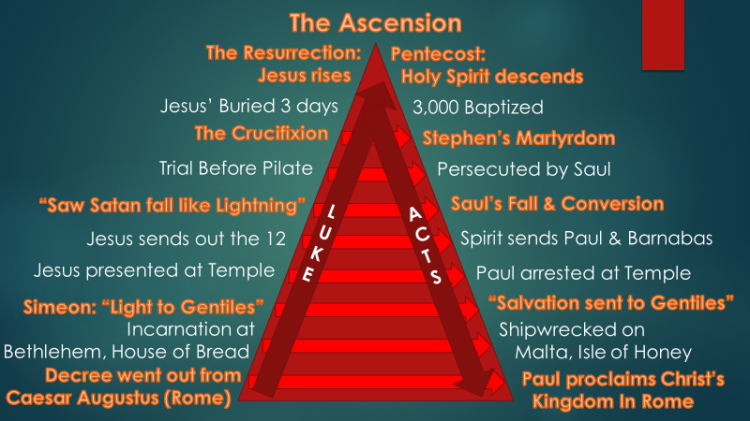
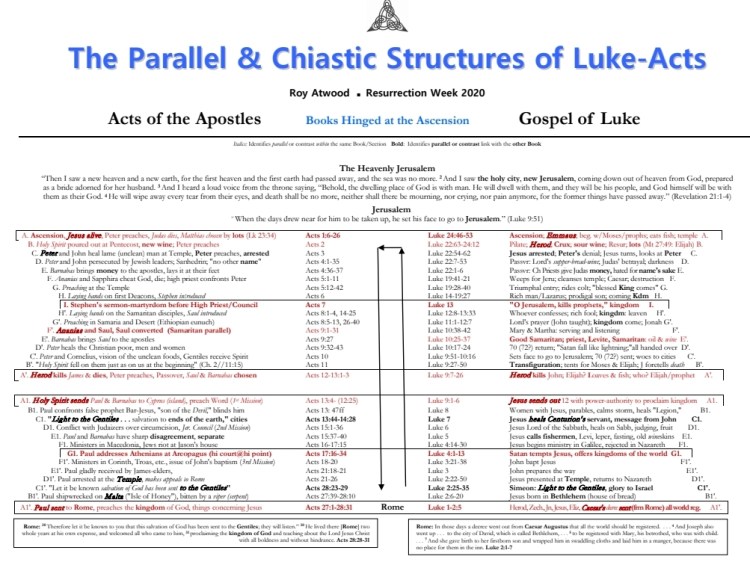
Charts & Diagrams
Missions
Trinity Reformed Church Sunday School Mini-Conference on Missions, February-March 2020
1. Key Changes & Challenges to 21st Century Missions
February 2, 2020 • Dr. Roy Atwood
2. Who’s Doing What, Where and Why: A Conversation
February 9, 2020 • Dr. Roy Atwood, John Hobbins
3. The Local Churches Role in Missions
February 16, 2020 • Dr. Roy Atwood
 Ascended King
You must be logged in to post a comment.