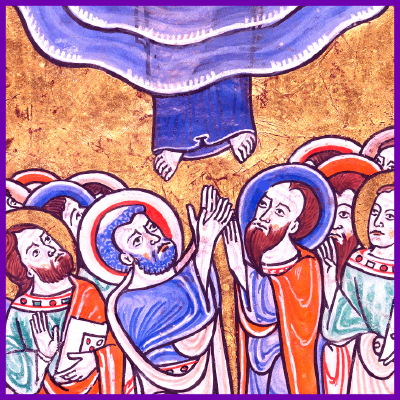
The bodily ascension of our Lord Jesus is one of the great doctrines of the Christian church. Sadly, it has fallen on hard times. It is arguably one of the most neglected doctrine among evangelicals and Protestants today. It is certainly among the least understood and least appreciated. Yet the ascension continues to play a doctrinally central role in the redemption story, our Christian lives, and the church today.
And I mean central quite literally, not merely metaphorically.
The ascension—not the incarnation, not the passion, not the cross, not the resurrection, not Pentecost—is at the center, the heart of Christian soteriology and ecclesiology. It is the Archimedean point of history, because it is the focal point of our redemption, through which everything in the Scripture is viewed, around which the entire story of the redemption pivots, and from which everything touching the Christian life unfolds.
To neglect or to minimize the ascension, then, will have serious negative repercussions. Without a proper grasp of the ascension, the Bible itself is at risk of being misinterpreted, our theologies misguided, the mission of the church misunderstood, and our daily Christian lives misdirected. Those are large claims, but to understand why the doctrine of the ascension seems so foreign, so irrelevant to our discussions of Christian life today, we need to retrace our steps and see where the evangelical church wandered off the Ascension Trail the Lord marked for us in His Word so clearly.
From Lavish Festivity to Benign Neglect
For most of church history, the bodily ascension of Jesus was celebrated enthusiastically, as the spectacular climax to the Lord’s redemptive work and a principal foundation for the church’s birth and development. The early church fathers saw it on par with or superior to the other epic moments in the earthly ministry of Jesus—his advent, incarnation, suffering, crucifixion, death, burial, and resurrection. So great was the ascension’s importance for the early fathers, they insisted it be featured in our earliest and most cherished creed: “. . . He ascended into heaven and sits at the right hand of God the Father Almighty . . . .”[1]
Nearly every early church father, major medieval theologian, magisterial Reformer, and Puritan church doctor wrote effusively about and attributed great significance to the ascension and its theological and pastoral implications for the people of God and the redemption of the whole world.
A few examples: John Chrysostom, a 4th century saint, was widely cited in both the Western and Eastern traditions for his sermon on the ascension, in which he described Christ as offering “the first fruits of our nature to the Father.” He imagined how “the Father admired the gift, and on account of the worth of the offerer and the blamelessness of that which was offered, He received it with his own hands and placed the gift next to Him and said, ‘Sit thou at my right hand.”
In the 11th century, Bernard of Clairvaux described the commemoration of the ascension as “the consummation and fulfillment of [all] the other festivals and a happy ending to the whole journey of the Son of God.”
A few centuries later, Thomas Aquinas identified Christ’s ascension as “the true cause of our salvation” because “the very showing of himself in the human nature which he took with him to heaven is a pleading for us.”[2]
For those of us on the Protestant side of the Reformation, John Calvin, in the early 16th century, was particularly enthusiastic about the importance of the ascension. In his sermon on Acts 1:6-8, he argued that the ascension helps us to not “confine our attention to ourselves,” but to locate our identity elsewhere, thanks to the reconciliation and ongoing intercession Jesus makes for us with the Father.
“Thus, we look to our Head Who is already in heaven, and say,
‘Although I am weak, there is Jesus Christ who is my strength.
Although I am full of all miseries, Jesus Christ is in immortal glory
and what He has will sometime be given to me and I shall partake
of all his benefits.’”[3]
According Julie Canlis (Calvin’s Ladder, 2010), Calvin viewed the ascension “not so much as the displacement of the self, but the enlargement of the self,” such that the circumference of our identity now involves another person forever seated at the right hand of God the Father.[4]
The church fathers and the church throughout the ages, from the time of the ascension itself until just a few generations ago, celebrated our Lord’s ascension as one of the church’s most cherished gifts and often did so with lavish festivity.
Today, however, the evangelical liturgical calendar between Easter and Advent is as empty as Jesus’s tomb. In most of our Protestant and evangelical churches today, after volunteers box up the trappings of our Easter celebrations, the storage closet isn’t opened again until the start of another Advent. Few North American Christians could tell you when the Ascension (or Pentecost) occurred biblically or when it is scheduled on the church calendar (what church calendar?). Most, however, have no such problem telling you how wonderfully their church celebrates Advent, Christmas, and Easter, of course. Tragically, more American churches celebrate Independence Day more enthusiastically than the high point of Jesus’s enthronement as the High King of Heaven!!
This liturgical and theological neglect of the ascension among evangelicals and Protestants today has had profound consequences for misshaping the Christian worldview with an ascensionless theology and culture. By ignoring or downplaying our Lord’s bodily ascension, the church risks relegating Jesus to merely a kind of Gnostic “Lord of my heart.” It saps his own self-declaration in the preface to the Great Commission that “all authority in heaven and on earth” has been given to him (Matthew 28:18, echoing Genesis 1:1 and 2:1, 4) of its power and truth. Without the ascension, Jesus would not have the power to intercede on our behalf or the authority to send his followers into the world to baptize and teach about himself. The Great Commission would be reduced to a Pretty Good Suggestion. The authoritative proclamation of the Gospel is “Jesus is Lord” (Romans 10:7), which is only possible because of his ascension and enthronement. That is the truly Good News! Without the ascension, however, the “gospel” is deflated from the greatest news to a Nice Request, a mere pleading for people to “let Jesus into their hearts,” while he stands by powerlessly waiting for them to “decide.” Without the ascension, Jesus is the mere maker of possibilities in heaven and earth; he is no Lord. The neglect of the ascension thus deeply weakens the doctrine of Christ, the Gospel, evangelism, and the church.
Three Reasons for the Neglect of the Ascension
The tragic neglect of the ascension in the contemporary evangelical church has at least three reasons. The first two are quite understandable. Tim Chester and Jonny Woodrow, in their delightful little book, The Ascension: Humanity in the Presence of God, are amusingly blunt when they write, “Let’s be honest: the ascension of Jesus is weird.” It seems rather strange, indeed, even to the most devout believer, that the final act of Jesus’s earthly ministry should be him floating off into the clouds and out of sight. How odd, indeed. Why would the church want to celebrate or emphasize his departure? In fact, Jesus anticipated this problem in John 16. Jesus says that
“I tell you the truth: it is to your advantage that I go away,
for if I do not go away, the Helper will not come to you.
But if I go, I will send him to you.” (John 16:7)
The second reason is that the passion with which the church historically celebrated this doctrine seems unjustified by the stunning brevity of the Gospel accounts of the ascension event itself. The gospels according to Matthew and John[5] contain not a word about the event. Mark, apparently a man of few words and the author of the shortest gospel, gives us a fittingly brief summary of Jesus’s ascension in Mark 16:19:[6]
So then the Lord Jesus, after he had spoken to them,
was taken up into heaven and sat down at the right hand of God.
That’s it, Mark’s entire account of the ascension. Like Mark, the Apostle Luke’s report of the ascension is remarkably brief and understated. At the end of his Gospel (24:50-53), Luke gives the event barely half a sentence’s worth of attention:
(50) Then he [Jesus] led them out as far as Bethany and lifting up his
hands he blessed them. (51) While he blessed them, he parted from them
and was carried up into heaven. (52) And they worshiped him and returned
to Jerusalem with great joy, (53) and were continually in the temple blessing God.
Luke would compete with Mark for the Brevity Prize were it not for the fact that he goes on to tell the ascension story again at the start of his second volume, the book of Acts. This time Luke offers a few more contextual details, but his account in Acts (1:[1]6-9) remains quite short:
(6) So when they had come together, they asked him, “Lord,
will you at this time restore the kingdom to Israel?” (7) He said
to them, “It is not for you to know times or seasons that the Father
has fixed by his own authority. (8) But you will receive power
when the Holy Spirit has come upon you, and you will be my
witnesses in Jerusalem and in all Judea and Samaria, and to the
end of the earth.” (9) And when he had said these things, as they
were looking on, he was lifted up, and a cloud took him out of their sight.
These few partial sentences hardly compare to the four Gospel’s abundant details about Jesus’s birth, death, burial, and resurrection. It is understandable, then, why the church today would give such minimal attention to an event that apparently warranted so little comment by the Gospel authors.
But there is a third and more theologically rooted (and admittedly more debatable) reason for the ascension’s neglect in evangelical and Protestant circles. The birth of the new American evangelicalism and revivalism associated with the Second Great Awakening drastically reduced the scope of the Gospel to personal salvation. Intellectual and cultural historians, such as Richard Hofstadter,[7] George Marsden,[8] Mark Noll,[9] and more recently Molly Worthen,[10] offer some important intellectual and cultural insights to the important changes that took place in American Christianity during that era. Such cultural histories, however, often overlook how the priorities of the new revivalism’s reductionistic soul-winning “gospel” gutted the doctrinal and ecclesiastical center of Christendom itself. For the first time in church history, evangelicals concentrated almost exclusively on two doctrines: the substitutionary atonement of Jesus’s death and his resurrection from the dead.
Jesus paid for our sins by his death and he gave us new life by rising miraculously from the dead on the third day. On those two doctrines, the crucifixion and the resurrection, hang all the law and the prophets of modern evangelicalism and Protestantism. Preaching the gospel soon meant (and still means for many) simply preaching those two doctrines to sinners that they might be born again. By that theological reductionism of the Gospel to faith in soteriology alone, the ascension became essentially irrelevant to evangelism and to the theological priorities of the new evangelical church preoccupied with personal salvation.
That new theological recentering rendered irrelevant or tangential more than just the ascension. In the wake of the Great Awakening, scholarship and academic inquiry were treated as soul-endangering distractions from soul-winning and personal evangelism. The two driving evangelical doctrines of the substitutionary atonement and resurrection alone were insufficient to provide a foundation for Christian education. Kids should be witnesses to the lost, not off studying with other Christians. Thus, a key reason why Christian education declined after the late 19th century is because broad and deep liberal learning and specialized training for various professions were simply considered irrelevant to evangelicalism’s myopic soul-winning goals supposedly demanded by a reductionistic interpretation of the Great Commission.
No Ascension, No Great Commission
The Great Commission in Matthew 28 and the “born again” verse of John 3:16 may be the Great Evangelical Prooftexts, but even a cursory glance at these passages confirms some crucial information largely missing from the common evangelical mantras.
The Great Commission does say, “Go therefore and make disciples of all nations, baptizing them in the name of the Father and of the Son and of the Holy Spirit, teaching them to observe all that I have commanded you.” But the reason, the basis for why Jesus can say “therefore” is because the necessary preconditions for commissioning his disciples have been met. Jesus can issue his command precisely because “All authority in heaven and on earth has been given to me.” Now, go therefore and make disciples of all nations . . . .” When was all authority in heaven and on earth given to him? At the incarnation? crucifixion? resurrection? No. That authority was only fully his to exercise at his ascension to the right hand of the Father.
When Christ’s ascended, as told by the Apostle John from a heavenly perspective, from the very throne room of God (Revelation 4:2ff; 1:10, 4:2), we immediately witness his coronation. John first saw a scroll with seven seals at God’s right hand that “no one was worthy to open or to look into it” (5:3). So John began to weep. But he was told to stop weeping because “the Lion of the tribe of Judah, the Root of David, has conquered, so that he can open the scroll and its seven seals” (5:5). What John reported in his Revelation account was the exaltation of the ascended Jesus to right hand of the throne of God the Father–the same events described by Luke in Acts from an earthly perspective, but blocked by clouds from our earth-bound vantage, but in Revelation 5 we see, thanks to John’s eyewitness account, the great coronation of the King of kings:
“Weep no more; behold, the Lion of the tribe of Judah,
the Root of David, has conquered, so that he can open
the scroll and its seven seals.”
6 And between the throne and the four living creatures and
among the elders I saw a Lamb standing, as though it had been
slain, with seven horns and with seven eyes, which are the
seven spirits of God sent out into all the earth. 7 And he went
and took the scroll from the right hand of him who was seated
on the throne. 8 And when he had taken the scroll, the four
living creatures and the twenty-four elders fell down before
the Lamb, each holding a harp, and golden bowls full of incense,
which are the prayers of the saints. 9 And they sang a new song,
saying,
“Worthy are you to take the scroll and to open its seals,
for you were slain, and by your blood you ransomed people
for God from every tribe and language and people and nation, 10
and you have made them a kingdom and priests to our God,
and they shall reign on the earth.”
11 Then I looked, and I heard around the throne and
the living creatures and the elders the voice of many angels,
numbering myriads of myriads and thousands of thousands, 12
saying with a loud voice,
“Worthy is the Lamb who was slain, to receive power and
wealth and wisdom and might and honor and glory and blessing!”
13 And I heard every creature in heaven and on earth and
under the earth and in the sea, and all that is in them, saying,
“To him who sits on the throne and to the Lamb be blessing
and honor and glory and might forever and ever!” (Rev. 5:5-13, ESV)
Tim Chester stresses the importance of the ascension and exaltation of Jesus wonderfully when he says, without the ascension, there is no Great Commission.[11] No King Jesus. No Spirit poured out on the Church. No Church militant. No bride for the Bridegroom. The crucifixion and resurrection are necessary for our salvation, of course, but they are insufficient grounds by themselves for the commissioning of the church. Jesus’s ascension and enthronement are the ground and pillar of the evangelical mission of the church. No ascension, no Great Commission. The Great Commission is only possible because of the ascension and exaltation of Jesus; the crucifixion and the resurrection alone cannot carry us far enough.[12]
Likewise, the significance of the great expression of God’s love for the world through Jesus, in John 3:16, expands cosmically when it ceases to be a decontextualized proof text and is considered, instead, in its fuller context. When Nicodemus comes to Jesus and their discussion unfolds, the following exchange occurs immediately preceding verse 16:
(9) Nicodemus said to him, “How can these things be?” (10)
Jesus answered him, “Are you the teacher of Israel and yet
you do not understand these things? (11) Truly, truly, I say
to you, we speak of what we know, and bear witness to what
we have seen, but you do not receive our testimony. (12)
If I have told you earthly things and you do not believe,
how can you believe if I tell you heavenly things? (13)
No one has ascended into heaven except he who descended
from heaven, the Son of Man. (14) And as Moses lifted up
the serpent in the wilderness, so must the Son of Man be lifted
up, (15) that whoever believes in him may have eternal life.
(16) For God so loved the world . . .”
(John 3:9-16a; ESV; emphasis added).
The Gospels histories may have been light on accounts of the ascension event itself, as we noted earlier, but the Bible overflows with such references to the ascension and its implications for the people of God.
Let me highlight briefly a few more Scripture passages that emphasize the ascension. Jesus himself explained the importance of his ascension to his disciples in John 16, when he said,
(7) . . . I tell you the truth: it is to your advantage that
I go away, for if I do not go away, the Helper will not
come to you. But if I go, I will send him to you. (8) And
when he comes, he will convict the world concerning
sin and righteousness and judgment: (9) concerning sin,
because they do not believe in me; (10) concerning
righteousness, because I go to the Father, and you will
see me no longer; (11) concerning judgment, because
the ruler of this world is judged. (John 16:7-11; ESV)
The Apostle Paul’s epistles contain multiple expositions on the ascension. For example, in Ephesians 1, Paul stresses Christ’s exaltation to the right hand of His Father:
I do not cease to give thanks for you, remembering you
in my prayers, (17) that the God of our Lord Jesus Christ,
the Father of glory, may give you the Spirit of wisdom and
of revelation in the knowledge of him, (18) having the eyes
of your hearts enlightened, that you may know what is the
hope to which he has called you, what are the riches of his
glorious inheritance in the saints, (19) and what is the immeasurable
greatness of his power toward us who believe, according to
the working of his great might (20) that he worked in Christ
when he raised him from the dead and seated him at his
right hand in the heavenly places, (21) far above all rule and authority
and power and dominion, and above every name that is named,
not only in this age but also in the one to come. (22) And he put
all things under his feet and gave him as head over all things
to the church, (23) which is his body, the fullness of him
who fills all in all. (Eph 1:16-23; ESV)
In Ephesians 4, from which I drew the title of this article, Paul stresses how the ascension was indispensable to the maturing of the church and the equipping of God’s people:
(8) Therefore, it says, “When he ascended on high he led a host of captives,
and he gave gifts to men.” (9) (In saying, “He ascended,” what does it
mean but that he had also descended into the lower regions, the earth?
(10) He who descended is the one who also ascended far above
all the heavens, that he might fill all things.) (11) And he gave the apostles,
the prophets, the evangelists, the shepherds and teachers, (12) to equip
the saints for the work of ministry, for building up the body of Christ,
(13) until we all attain to the unity of the faith and of the knowledge
of the Son of God, to mature manhood, to the measure of the stature
of the fullness of Christ, (14) so that we may no longer be children,
tossed to and fro by the waves and carried about by every wind of doctrine,
by human cunning, by craftiness in deceitful schemes. (15) Rather,
speaking the truth in love, we are to grow up in every way into him
who is the head, into Christ. (Eph. 4:8-15; ESV)
The Ascension and the Giving of Gifts
The ascension is the great event God uses to give gifts to the church, namely, aspostles, evangelists and teachers. Without the ascension, there would be no education and no teachers gifted to teach in the name and under the authority of Christ Jesus.
Paul’s argument in Ephesians 4 hinges on his deep understanding of the Torah and the role of ascents and in the Old Covenant economy. In verse 8, he quotes Psalm 68:18–but with an odd twist. The Psalmist wrote,
You ascended on high, leading a host of captives in your train and
receiving gifts among men, even among the rebellious, that
the LORD God may dwell there. (Psa. 68:18; ESV; emphases added)
But that’s not what Paul wrote to his Ephesian audience. He quoted from neither the Hebrew text nor the Septuagint. Instead, he said,
“When he ascended on high he led a host of captives, and hegave gifts to men.”
Paul altered the Psalm by replacing the key for verb receiving (gifts) for the verb for giving (gifts)! This is rather disturbing for those of us who take the inerrancy of Holy Scripture seriously. What’s going on here? How could Paul do that? We could get all sidetracked on various textual and exegetical rabbit trails regarding Paul’s word change between Psalm 68 and Ephesian 4, but two observations may be helpful for our greater appreciation of the ascension and Paul’s perspective on it.
Old Covenant saints and Jews steeped in the Torah, the Histories and the Prophets, like Paul, would have understood that every ascent to Yahveh, when done in covenant faithfulness—whether it was an ascension offering, an ascent up a mountain, an ascent to the Temple, an ascent to an altar, or a going up to Jerusalem—would receive a blessing from the Lord on the other, descending, side of that experience. All those who ascend to the Lord in faith receive gifts from the Lord on their return. Two Old Testament examples illustrate the point:
- When the people of God brought their regular animal sacrifices to the Tabernacle or Temple, the priests placed the animals on the fire. The people would watch their offerings ascend bodily in smoke from the altar to the heavens, into the very presence of God. Throughout Leviticus, wherever the Hebrew word `olah is rendered “burnt offering,” as it is unfortunately translated in most of our English versions, we encounter a meaning quite at odds with the biblical imagery intended. Of course, the animal sacrifices were consumed by fire, and “burnt” in that narrow sense, but `olah does not mean “burnt” or judgment by fire. Rather, it means “to ascend” or “that which ascends.”[13] When the ascension offering, as it should be more accurately called, ascended into heaven, and God received it, He poured out blessings just as he promised: forgiveness of sins, his mercy, his protection, his grace, the covenant inheritance he promised to Abraham. Once we realize that the entire so-called “burnt offering” system of the Old Covenant required the bodily ascension of a substitutionary sacrifice for sins to the Throne of Heaven, then the typology of the Torah on this crucial point is finally fulfilled in the New Covenant. The ascension offerings were a type, a prefiguring of Jesus’s own ascension that would soon come.[14]
- When faithful Abraham took Isaac, the son of promise, up Mount Moriah to sacrifice him as an ‘olah, an ascension offering, as the Lord commanded him to do in Genesis 22, the Lord intervened at that most dramatic moment, when Abraham’s arm was poised to slay Isaac. It says in 22:13f, that Abraham lifted up his eyes and there, behind him was a ram, caught in a thicket by its horns, and he took the ram and offered it up as an ascension offering, instead of his son. So Abraham named the place, “‘The LORD will provide;’ as it is said to this day, ‘On the mount of the LORD it shall be provided.’” As they were about to descend, the Lord gave him his great covenantal promise, saying (22:16-18), “By myself I have sworn, declares the LORD, because you have done this and have not withheld your son, your only son, I will surely bless you, and I will surely multiply your offspring as the stars of heaven and as the sand that is on the seashore. And your offspring shall possess the gate of his enemies, and in your offspring shall all the nations of the earth be blessed, because you have obeyed my voice.” Abraham ascended the mount in faith and descended blessed beyond measure. Again, the typology here offers a wonderful picture of what God does for us by offering his only Son in our place and blessing us and the universe through that matchless act of love and grace.
- When Moses ascended Mount Sinai in the wilderness (Exodus 19:2-3), the people of Israel were uncertain what would happen next. When he didn’t return, they fell back into the idolatry of Egypt and made themselves a golden calf. But when Moses finally descended from the mountain, the Lord had given him the tabletsof the Law and plans for a place of worship where they could ascend on a weekly basis into his holy presence. In Exodus 25:8-9, the Lord tells Moses, “Make me a sanctuary, that I may dwell in their midst. Exactly to the pattern of the tabernacle, and of all its furniture, so you shall make it.” Moses ascended in fear, but returned blessed with the plans for the house of the Lord, where God would dwell among his people and all his people would have perpetual access to his holy presence. (This idea is explicitly developed in Hebrews).[15]
- In 2 Sam 2:1-7, David asks the Lord if he should “ascend” (‘alah) to the cities of Judah, and the Lord replies, “Ascend.” Once he, his men and all their families settle in the cities of Hebron, David is anointed King of Israel. When he next descends, he comes as God’s own anointed king and a man after God’s own heart.
What Paul did in Ephesians 4:8 was not an impulsive or careless altering of the meaning of the text of Psalm 68:18, but rather a recapitulation of the broader scope and understanding of the nature of ascents found across the Torah and the Old Covenant, and which every Jew would have certainly understood. Moreover, Paul knew firsthand how, when Jesus had ascended to heaven, he blessed the church by sending the gift of the Holy Spirit at Pentecost and gifts to men, quite consistent with the scope of meaning of Psalm 68.
Exalted Above Every Name
These Old Covenant examples echo throughout Paul’s many discussions of the ascension in his epistles. In Philippians 2, for example, he establishes the eschatological glory of Christ on the ascension, when he says:
Therefore, God has highly exalted him and bestowed on him the name
that is above every name, (10) so that at the name of Jesus every
knee should bow, in heaven and on earth and under the earth,
(11) and every tongue confess that Jesus Christ is Lord, to the
glory of God the Father. (Php 2:9-11; ESV)
Paul’s challenge to the Colossians to be heavenly minded in their Christian lives is based directly on the implications of the ascension stated explicitly in chapter 3:
If then you have been raised with Christ, seek the things that
are above, where Christ is, seated at the right hand of God.
(Col 3:1; ESV)
The author of Hebrews (Paul?) gives the ascension a central role in that book as well. In the first chapter, when he notes that after purifying the world of sin, Jesus was exalted and enthroned at his Father’s side in heaven, the author writes:
He [Jesus] is the radiance of the glory of God and the exact
imprint of his nature, and he upholds the universe by the word
of his power. After making purification for sins, he sat down
at the right hand of the Majesty on high. (Heb 1:3; ESV)
In chapter 2, the author connects the ascension to Psalm 8:4-5.
(6) It has been testified somewhere, “What is man, that you are mindful
of him, or the son of man, that you care for him? (7) You made him for a little
while lower than the angels; you have crowned him with glory and honor,
(8a) putting everything in subjection under his feet.” (Heb 2:6-8a; ESV)
And in the first two verses of Hebrews 12, at the end of that great roll call of the saints who stood by faith, not by sight, the author writes,
Therefore, since we are surrounded by so great a cloud of witnesses,
let us also lay aside every weight, and sin which clings so closely,
and let us run with endurance the race that is set before us, looking to Jesus,
the founder and perfecter of our faith, who for the joy that was set before him
endured the cross, despising the shame, and is seated at
the right hand of the throne of God. (Heb. 12:1-2; ESV)
Everywhere in Scripture where one encounters mention of the lordship of Jesus or his kingship, the ascension story can be heard echoing in the background. The New Testament is so full of these kinds of references to Christ’s lordship and the ascension that we almost grow blind to them. It’s a bit like living near some spectacularly beautiful natural wonder, like Mount Rainier, but forgetting it’s there after living in its shadow for many years.
The Ascension as the Chiastic Center of the Gospel
Modern readers, unlike the ancients, give little attention to the structure of a story. Modern, info- and data-hungry, English Bible readers often miss the amazing design and structures of the biblical texts, which give author-provided focus and emphasis to what is being said. Just one spectacular example can be found in the structure of Luke-Acts, Luke’s two-volume work.
Luke wrote the two parts of Luke and Acts in a beautifully arranged chiastic (or X-like) structure, taking a form something like a mountain or the two covers of a book hinged at the binding. At the base in Luke’s Gospel is the long preface in chapter 1 that contains the prophecies of the births of John the Baptist and Jesus. Luke deliberately associates Elizabeth and Mary with Hannah, and their children to Samuel and David, who Samuel anointed king of Israel. Luke makes the typologies quite explicitly. Then the structural fun really begins.
In Luke 2, a decree goes out from Caesar Augustus, emperor of the world’s great superpower in Rome.
And Simeon declares that Jesus is the light to the Gentiles and the glory of Israel.
In Acts 28, Paul is preaching Christ and his kingdom in Rome
And Paul says let it be known the salvation of God has been sent to the Gentiles
In Luke 4, Satan takes Jesus up a high mountain and tempts him with the kingdoms of the world
In Acts 17, Paul appears before the high court at the high place of Athens and declares King Jesus
In Luke 9, Jesus sends out the 12 with power to declare his kingdom
In Acts 13, the Holy Spirit sends out Paul and Barnabas to preach Christ’s kingdom
In Luke 9, Herod kills John
In Acts 12, Herod kills James (and dies)
In Luke 10, Jesus tells the story of the Good Samaritan
In Acts 9, Converted Paul is blind, helpless on a road and Ananias comes to take care of him at an inn
In Luke 13, Jesus grieves for Jerusalem, “O Jerusalem, Jerusalem who kills the prophets.”
In Acts 7, Stephen is martyred at the Temple in Jerusalem and sees Jesus at the right hand of the Father!
In Luke 22, the Chief Priest gives lays money at Judas’ feet
In Acts 4, Barnabas brings money to the Apostles and lays it at their feet
In Luke 23, Jesus is crucified and given old sour wine
In Acts 2, the Holy Spirit is poured out and the saints are accused of drinking too much new wine
In Luke 24, Jesus ascends
In Acts 1, Jesus ascends
The crux of Luke-Acts, the chiastic center of Luke’s story of Jesus and the early church, the hinge on which the whole ministry of Jesus and the extension of his Kingdom from Judea, Samaria and to the ends of the earth pivots, is the ascension.
Endnotes
*Adapted from Roy Alden Atwood, “When He Ascended on High: The Ascension’s Centrality for Christian Education,” New College Franklin Collegium, Franklin, TN, September 1, 2016
[1] About A.D. 180, Roman Christians developed an early form of the Apostles’ Creed to refute the Gnostic errors taught by Marcion and his followers. The later Nicene creedal inclusion of the bodily ascension of Jesus was one of the key elements to refute Marcion’s heresies.
[2] All citations in this paragraph are taken from Douglas Farrow, Ascension Theology, London: Bloomsbury, 2011, pp. 40-41
[3] John Calvin, Sermons, Acts 1:6-8. Cited in Julie Canlis, Calvin’s Ladder: A Spiritual Theology of Ascent and Ascension, Grand Rapids: Eerdmans Publishing, 2010, p. 115.
[4] Ibid.
[5] John provides anticipatory allusions to Jesus’s ascension and return to his father in 1:18; 3:13; 6:62; 14:2; and 20:17.
[6] See also Mark 14:62, echoing Matt. 26:64 (see footnote 1 above).
[7] Richard Hofstadter, Anti-Intellectualism in American Life, 1964.
[8] George Marsden, Fundamentalism and American Culture, 1981; Understanding Fundamentalism and Evangelicalism, 1990.
[9] Mark Noll, The Scandal of the Evangelical Mind, 1994; America’s God: From Jonathan Edwards to Abraham Lincoln, 2002; The Rise of Evangelicalism: The Age of Edwards, Whitefield and the Wesleys, 2004.
[10] Molly Worthen, Apostles of Reason: The Crisis of Authority in American Evangelicalism, 2014.
[11] Tim Chester and Jonny Woodrow, The Ascension: Humanity in the Presence of God, 2013, p. 8.
[12] Note that the command in the Great Commission is to disciple the nations (not just individuals) and to teach the disciple-nations all that Jesus taught, which is all knowledge and wisdom in heaven and on earth, not just “soul-winning” entry into the church.
[13] Jacob Milgrom, Leviticus, 1-16, The Anchor Yale Bible Commentary Series, 3 Vols., Yale University Press, 1991 (1998), p. 172.
[14] James Jordan, “Getting the Translation Right,” Biblical Horizons, 78 (October 1995)
[15] See Heb. 12:18-29 for how the Moses-Jesus ascensions are explicitly compared by the author of Hebrews: “For you have not come to what may be touched, a blazing fire and darkness and gloom and a tempest (19) and the sound of a trumpet and a voice whose words made the hearers beg that no further messages be spoken to them. (20) For they could not endure the order that was given, “If even a beast touches the mountain, it shall be stoned.” (21) Indeed, so terrifying was the sight that Moses said, “I tremble with fear.” (22) But you have come to Mount Zion and to the city of the living God, the heavenly Jerusalem, and to innumerable angels in festal gathering, (23) and to the assembly of the firstborn who are enrolled in heaven, and to God, the judge of all, and to the spirits of the righteous made perfect, (24) and to Jesus, the mediator of a new covenant, and to the sprinkled blood that speaks a better word than the blood of Abel. (25) See that you do not refuse him who is speaking. For if they did not escape when they refused him who warned them on earth, much less will we escape if we reject him who warns from heaven. (26) At that time his voice shook the earth, but now he has promised, “Yet once more I will shake not only the earth but also the heavens.” (27) This phrase, “Yet once more,” indicates the removal of things that are shaken—that is, things that have been made—in order that the things that cannot be shaken may remain. (28) Therefore let us be grateful for receiving a kingdom that cannot be shaken, and thus let us offer to God acceptable worship, with reverence and awe, (29) for our God is a consuming fire. (ESV; emphasis added)
 Ascended King